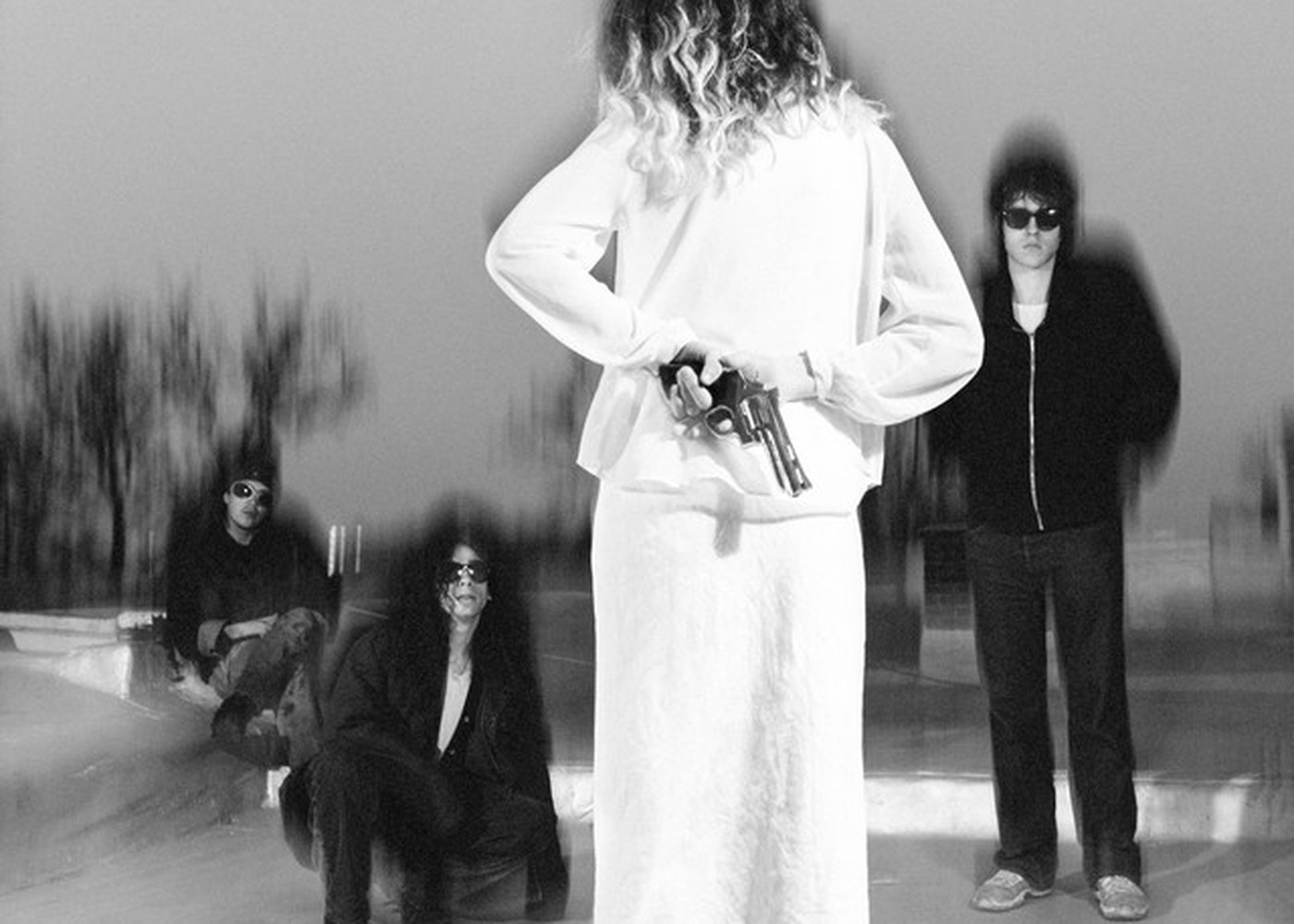
RY X's "Lay" treats being healed and being hurt as a single act: the narrator comes back together only by asking to be wounded again and again in the dark.
Hans Williams's "Holey Fence" is a vow to someone gone that the narrator can't keep, and the endless "make it right" is a lullaby sung for their own sake.
Current Joys's HALLOWEEN is about wanting to see someone without being seen, and the love spell in its bridge turns a lonely plea into outright possession.
Nickelback's "If I Don't Go" swears the narrator must leave a dying small town, then drags them back to it. The escape never happens. Here's why that matters.
In Amira Elfeky's "I don’t want to fall in love," the refusal is failing: the narrator fears loving alone, not love itself, and is already halfway down.
The Flaming Lips frame childhood freedom and existential dread as the same game. Trust the universe, keep laughing, and run before the dark wins.
Queens of the Stone Age's "Run Away From the Mob" argues the mob's real weapon is the polite signed apology, and that running away only buys you grief.
"Richard 2" is a song about performing confidence so hard it cracks, and the purple-prosing demon is where the mask finally slips.
waterbaby's "Creek" turns a dark descent into an escape plan: love in the water teaches the narrator to shed the body and become music, color, and photograph.
DIIV's "Dare Me" is about a narrator who wants to act but only if someone else makes it their idea, keeping the one thing they want buried out of reach.
Dean Johnson's "Perfect Stranger" mourns lost distance more than lost love: the narrator wants back the spell, not the woman. Here's how the lyrics prove it.
In Nick Hakim's "The Light," the narrator's certainty grows louder as the promised reunion slides into the future. "I ain't dreamin'" is the real giveaway.
In Nick Hakim's "Cold," the narrator swears five times she's never coming back, a spell meant to make a goodbye true that the heart hasn't accepted yet.
In Nick Hakim's "I Don't Know," one pronoun shift turns grief for someone gone into curiosity about where we all go, and the not-knowing becomes company.
Champion Trees' "Higher Taste" admires a world that never pretends, sung by someone who can't stop. The comfort is real, and so is the gap it leaves open.
Champion Trees turns a failed bid for an original voice into a family tree, finding lineage in the very line where the narrator openly admits to copying.
Champion Trees's song argues that drifting and not understanding can be a form of attention, and its only real movement is one small lean forward at the end.
Katie Gavin's "Inconsolable" fears being seen more than being alone, and its baby lizard hope secretly points toward running away, not toward being held.
Katie Gavin's "The Baton" uses an imagined daughter to rehearse a harder truth: an aging mother yelling "go," and the guilt of finally taking the handoff.
Katie Gavin's "As Good As It Gets" turns disappointment into a vow, arguing that a love you're let down by for decades is the most romantic promise there is.
In Katie Gavin's "Aftertaste," a narrator braced for pity misreads tenderness, and the only voice saying it's too late is her own. Here's the full reading.
Dean Johnson's "Death of the Party" roasts someone who never stops talking, but the narrator's own repeating tirade turns the whole roast into a confession.
In Dean Johnson's "The Man in the Booth," a man at his stand rehearses a perfect pitch to a passing stranger and never says it. The rehearsal is the romance.
Dean Johnson's "Before You Hit the Ground" starts as a songwriter failing to catch the sun and ends as grief: the light was with the person they lost, setting.
"Mr. Marketer" maps the slow erosion of an artist who can't tell if she's sharing her truth or just bleeding for buyers. Here's what every image means.
Jonah Kagen's "Words From A Wandering Man" argues that staying is worth it even when you can't justify why. Here's what every line means.
"Drink By Fires" argues that love isn't something to find but something already woven into daily life, if you stop searching long enough to notice.
Jonah Kagen's "Better Than You" fears being fully known by someone who stopped caring more than losing them. Here's how the lyrics prove it, line by line.
Jonah Kagen's "Eternity of Anything" claims forever is already here, then spends the song waiting for someone to tear off armor the narrator won't remove.
Jonah Kagen's "4AM" turns a 4 a.m. heartbreak question into a confession: the narrator's recovery plan, meds and all, is the most worrying part of the song.
Jonah Kagen's "Every Time I Come Around Here" says it can't help it, but the narrator keeps choosing the road back and keeps that book on the shelf on purpose.
Jonah Kagen's "Ain't Convinced" traps grief in a loop of fire, opening with ash and ending with a match, and its last line asks a question nobody answers.
Jonah Kagen's "Silhouette" drops needing a lost love but never wanting them. The chorus answers a question nobody asked, and the outro gives the game away.
Jonah Kagen's "Do Better" sounds like an ultimatum, but the narrator has already left. By autumn, real love belongs to the crowd, the band, and himself.
"Don't Feel Right" shows a vow to quit a bad love collapsing in real time, and its final admission, "I couldn't quit if I tried," is its first honest line.
Jonah Kagen's "I Have An Image" is a song about carrying a vision of love so total it survives death itself. Here's what every line means.
Momma's "Stay All Summer" is a cheating song where the narrator begs the new lover to say yes first, so the betrayal can belong to someone else entirely.
In Gracie Abrams's "Here You Come, There You Go," the narrator blames an ex for coming back, but her own lines reveal a healing that was built to come undone.
Momma's "Ohio All The Time" sounds reckless, but its chorus is a plea for permission: a narrator running toward trouble who needs someone to say it's right.
Dominic Fike's "SPOTLIGHT / INNER CHILD" trades a surveillance nightmare for a phone call, and argues a voice that answers is the only vice worth keeping.
"Rodeo" is about being trapped inside someone else's orbit, desperate to leave but unable to. Momma makes the hook a confession and a cry for help.
WAR MACHINE turns safety into guilt: the narrator watches a gunship pass, shrugs, and the shrug becomes a confession of being on the side that owns the plane.
Momma's "I Want You (Fever)" turns a demand for honesty into a weapon: the narrator wants the truth told only because the truth means winning the affair.
Dominic Fike's NOT THE SPIRIT treats 'it happened for me' as cooked books: the mirror man narrates a comeback the broke-math chorus refuses to sign off on.
Horsegirl's "Rock City" uses a lonely shepherd as a warning: the outro's young man is watching his own forty-year future and losing his appetite for it.
"Dusty" argues that loneliness isn't something you escape but something you carry - and that wherever you go, you're already there waiting.
CABBY by Dominic Fike stacks up alibis from a narrator who lives behind the wheel, until the bridge drops the excuses and admits love is a failed miracle.
Hannah Cohen's "Mountain" turns grief into a loop the narrator chooses on purpose, keeping a lost friend aloft by refusing to let the song, or them, land.
LILY WAS A CAVALIER is Dominic Fike processing sudden wealth and social vertigo through surreal imagery that never quite lets you get comfortable.
Hannah Cohen's "Earthstar" builds its love on hedges. The narrator swears they know a sleeping partner, but the only truth left is that people always change.
Dominic Fike's RENO sells a midnight getaway, then cuts the narrator off mid-word. The trap it warned about was the one the narrator walked into alone.
"Summer Sweat" holds two contradictions at once: craving release and craving more. Hannah Cohen turns summer heat into an ache that never quite resolves.
WHITE KEYS is about pouring yourself into someone who was always too big for you to hold. Here's what every line actually means.
In "Get Your Head Out," Jessica Pratt's narrator gives orders to a lover but is really talking to themselves, trading guilt for a compulsion they can't quit.
HONEYLOVE turns a love song into a plea to be rebuilt by someone else, and its looping outro admits that rescue was just another awful sound you settled for.
"The Last Year" is a quiet act of self-deception: the narrator performs hope so convincingly that the performance becomes indistinguishable from belief.
DOOMSDAY argues that when time dissolves into a screen-lit blur, love becomes the only thing the narrator can still locate. Here's what it means.
Jessica Pratt's "World on a String" watches a woman hold the world and decides it's better to be the warm trace left behind: sunlight first, then a vestige.
"CASTING CALL" is about the gap between a promise and a night: a narrator directing their own chaos, sober for right now, already drifting toward relapse.
Jessica Pratt's "Life Is" pictures a narrator who is both jailer and prisoner, so every lucky escape turns out to be one more trick played on themselves.
In Dominic Fike's "PANGEA," the narrator calls Cristal cheap and skips AA as trite, but one woman behind a 13th-floor door is the price they can't pay.
Haley Heynderickx's "Fluorescent Light" indicts a market that sells everything, starting with the cross, and answers it with a single phone switched off.
"WALLFLOWER" sounds like a takedown but it's actually a plea for permission to fall apart. Fike wraps desperation in insults and calls it love.
"Joker Lips" is MJ Lenderman's most nakedly vulnerable song dressed in his grossest details. It's about needing to be needed, badly.
Haley Heynderickx's "Cowboying" follows a narrator who calls others takers while taking everything, then admits the ignorance might be comfortably chosen.
Haley Heynderickx's "to each their dot" catches its narrator mid-fight: the clarity it claims is self-recognition, and the chorus mourns what we've become.
"Bottom of a Bottle" turns barroom jokes into a real prayer: the lost woman is an alibi, and once the friends stop fishing, only God is left to call on.
Julien Baker's "Sylvia" is a leaving song where the choice is already made. What's left is guilt, uneven time, and a desperate plea not to be forgotten.
Julien Baker's "Dirt" is about a narrator who only hears a hard truth when it's yelled, so the whole chorus becomes the narrator screaming it at themselves.
"Sugar in the Tank" maps the gap between total devotion and total paralysis, where the love is real but the narrator can't make themselves move.
Bon Iver's "Everything Is Peaceful Love" sings calm acceptance from up a tree, and that perch exposes the peace as a gentle escape from a slow goodbye.
Bon Iver's "From" sounds like patient reassurance, but every soothing line is a disguised plea from a narrator terrified the relationship is slipping away.
Bon Iver's "THINGS BEHIND THINGS BEHIND THINGS" treats endless depth as a trap: the narrator's only rival is their own mirror, and every win is a loss.
S P E Y S I D E is a confession of irreversible damage, where the narrator strips self-deception bare and asks if anything human remains.
Alex G's "Beam Me Up" follows a worn-out player who helps shoot runaways yet begs to be taken, and stops caring whether the exit is rescue or abduction.
Alex G's "Real Thing" starts as a search for something genuine and ends as a self-audit, with the narrator asking someone younger to certify them as real.
Alex G's "June Guitar" turns the end of a rope into a swing. The narrator swings freely through heartbreak, then refuses to finish the one plea: don't make me.
Alex G's "Afterlife" hears God and the TV through the same speaker. Its narrator takes salvation anyway, knowing full well the prayer might be a baited hook.
In Samia's "Lizard," a narrator insists they're being misread, then ends daring someone to look. The chorus's "don't do it" loses, and the song knows it.
Samia's "Sacred" is about envying a lover's hate: the narrator wanted love as fierce as the anger they get, and the refrain turns from complaint into a wish.
Searows's "Dearly Missed" lets a betrayal harden one verb at a time, from "if I sell you out" to "I sell," ending in a confession posing as an obituary.
"Taxes" holds two positions at once: the narrator deserves punishment and refuses to submit. That contradiction is the whole song.
Samia's "North Poles" sounds like a love song, but its magnet simile proves two people too alike can only push apart, back to back in a kitchen at night.
Samia's "Bovine Excision" grants its narrator's wish to be untouchable, and the bloodless outro shows the cost. A bartender in verse four knows better.
Searows's "Dirt" is about being dragged back into your own body, and a narrator who wants the peaceful delusion back more than any kind of real healing.
Searows's "Photograph of a Cyclone" accuses someone of losing their words, but the narrator is the one who goes silent, humming instead of defending her.
Searows's "Belly of the Whale" argues that finding someone else in the dark changes nothing at all: the second person shares the fall instead of stopping it.
Waxahatchee's "Crowbar" is about a question the narrator refuses to ask, and how that clenched silence wrecks the one tool that could pry a relationship open.
Waxahatchee's "3 Sisters" starts as an accusation and ends as a confession: the narrator is built into the defenses of the person they can't stop blaming.
In Waxahatchee's "Right Back to It," the partner never wavers. The narrator invents the danger, then pretends to be the one who can't keep up with them.
Waxahatchee's "Much Ado About Nothing" is a confession dressed as a shrug. Every brag cracks, and the bridge proves the title is the narrator's final bluff.
Big Thief's "All Night All Day" makes sex a hymn by refusing to name its god. Here's what the poison, sugar, blood, and "love is just a name" really mean.
Big Thief's "Words" argues that breath, humming and fire carry love better than speech, and the café scene proves it when two people can only half-say.
Big Thief's "Los Angeles" argues that the deepest bonds survive precisely because they outgrow the physical. Here's what the lyrics actually mean.
Big Thief's "Incomprehensible" treats turning thirty-three as a fight over who gets to read your body, and the singer asks society to let them stay unreadable.
Wednesday's "Reality TV Argument Bleeds" casts the narrator as the tick: a clinging, unkillable love that refuses comfort and watches the wreck from the road.
MJ Lenderman's "Wristwatch" turns a roast into a brag list, then into a plea: the gadget watch only ever reports one thing, that the narrator is alone.
"100 Horses" argues that forced joy is its own form of violence. Geese builds a world where dancing and smiling are orders, not freedoms.
Backstage on the Laundry Day tour, LA’s 12-piece collective Illusion Hills talk their Discord-born lineup, creative roles without egos, and upcoming album
Lorem ipsum dolor sit amet, consectetur adipiscing elit. Suspendisse varius enim in eros elementum tristique.