

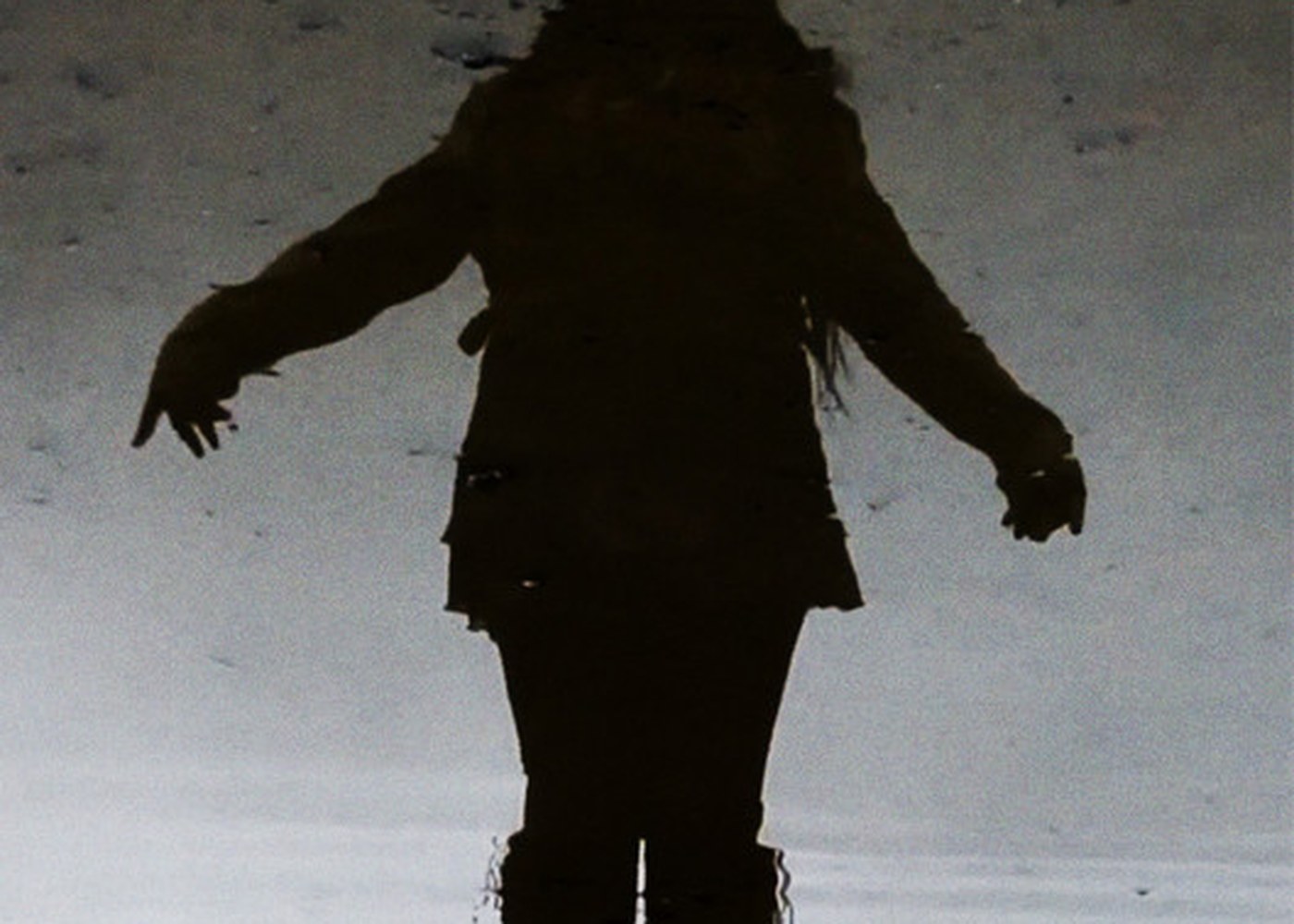
Being a body is the problem "Creek" is trying to solve, and its answer is to stop having one. The narrator starts with lips wrapped around a "hit-machine," gets swallowed by a forest, falls in love underwater, then decides the safest thing to be is a sound or a picture. By the final line they're shouting with joy about becoming flat paper. "Creek" is about fear of the flesh, and the song treats dissolving into music and image as a genuinely happy ending.
The forest eats from the edges in
The first thing in the song is a mouth. Whatever the hit-machine is, the lyric never names it, and it doesn't need to. The body opens, takes something in, and the world immediately closes around it.
"Lips grasped around the hit-machine / This steep dark forest has encompassed me"
Everything frightening stays at the margins. A "jaunting cowboy antique slaughter" flickers in the narrator's periphery like violence on old film, and "revolutions fox for my extremities," whether that fox is an animal or a verb. Either way, something is coming for the hands and feet, the far ends of the body. The self is getting nibbled down from the outside.
Then the narrator falls into the water and comes up "aloud and secure." Aloud. They rise as noise, a voice instead of a person, and they feel safe that way. The whole ending is hiding inside that one word.
Verse 3: the boy in the water
The haze clears for the song's tenderest stretch, and the language goes almost simple.
"I fell in love with the boy in the water / We reach inside each other"
Watch the tense. The narrator "fall[s]" into the water in the present, but "fell" in love in the past, as if the love was already waiting down there. And the love has no edges. Two people reaching inside each other is what bodies can't actually do on dry land. Underwater, skin stops being a wall, and the boy is the first proof the narrator gets that the borders of a body can give way without pain.
Then comes the strangest couplet in the song:
"I looked to the ground but all I could see / Was you and me and the human being"
That's three figures, and one of them is just called "the human being," like humanity tagged along on the date. My read is that the human being is the body itself, the flesh both lovers have slipped out of, left lying on the ground like a coat. The narrator looks down and sees their own species from outside.
A reasonable fan could push back hard here. The boy in the water might be a reflection, the narrator falling for their own face in the creek, and the "you and me" might be one person split by the surface. That reading makes the song lonelier, and the lyric never rules it out.
An empty bridge, then a sermon
The bridge has no words. After all that warmth, the song goes silent, and when the voice returns it has turned into a preacher.
"In a land of cigarettes, everybody's getting thinner / And the cancer's harvest in our land"
Sinners, eunuchs, a fight, a harvest of tumors. The narrator who started the song with lips on a smoking device now condemns a whole country made of smoke, and never connects the two. That blind spot is the engine of the dread. The body that took the hit is the same body the cancer comes to collect.
Notice that "everybody's getting thinner." These people are losing body, which is exactly what the narrator wants. In this verse, though, the subtraction is done to them by disease, and it's horrifying.
Verse 5: subtraction, one part at a time
So the narrator takes the knife into their own hands, hypothetically.
"If I had no balls I'd be a eunuch / If I had no brain I wouldn't care"
The first line is almost funny in its plainness. It's a dictionary definition delivered with the weight of a revelation, and it ties straight back to the land of eunuchs one verse earlier. Losing the brain comes next, and with it, caring. Each subtraction gets lighter instead of worse.
Then the body.
"If I had no body I'd be music / Just my essence floating in the air"
The narrator has gone from "I" to "if I," a self that only exists in the conditional, and that's the first time in the song they sound free. The forest, the cowboy, the cancer: all of it needs a body to hurt. Music has nowhere to be wounded. If you've ever lain awake at 3 a.m. with headphones on, waiting for a high to tip back from frightening into fine, you know exactly why this verse sounds like a long exhale.
The outro: a photograph laughing
After "All right, ooh yeah!" the narrator bursts out with the song's last and loudest claim.
"I'm a photograph! I can be any color you want me to be!"
A photograph is flat, copyable, and endlessly re-tintable. Nobody harvests cancer from a photograph. The narrator has found a second escape alongside music, and this one comes with an offer attached: whoever "you" is, the boy or the listener, gets to decide the color. That's tender and a little dizzy at once, a self handed over completely, shouted with exclamation points that sound closer to a giggle than a surrender.
Conclusion
"Creek" never heals the body. It outruns it, first into water, then into sound, then into a picture someone else can paint. You can hear that as dissociation dressed up as joy, but I believe the joy. The narrator came up from the water "secure" by being a voice, and the whole rest of the song is them learning to trust that feeling. In "Creek," the safest way to be loved is to become something that can be copied.
Frequently Asked Questions
What is "Creek" by waterbaby about?
"Creek" follows a narrator through a frightening, surreal descent into a dark forest, a love found underwater, and a bleak vision of cigarettes and cancer. It resolves that fear of the body by imagining an escape into music and a photograph, forms that can't be hurt and can be any color.
Who is "the boy in the water" in "Creek"?
The lyrics never name him. He can be read as a lover the narrator meets in a dreamlike underwater space where bodies can "reach inside each other," or as the narrator's own reflection on the creek's surface. Either way, he is the first moment of tenderness and safety in the song.
What does "If I had no body I'd be music" mean in "Creek"?
It is the climax of a list of imagined losses, from balls to brain to the whole body. After a verse full of death and cancer, the narrator pictures existing only as sound, an essence floating in the air that nothing can harm, which sets up the joyful photograph line that ends the song.
Lyric analysis powered by Scalpel.



Comments
Loading comments…