

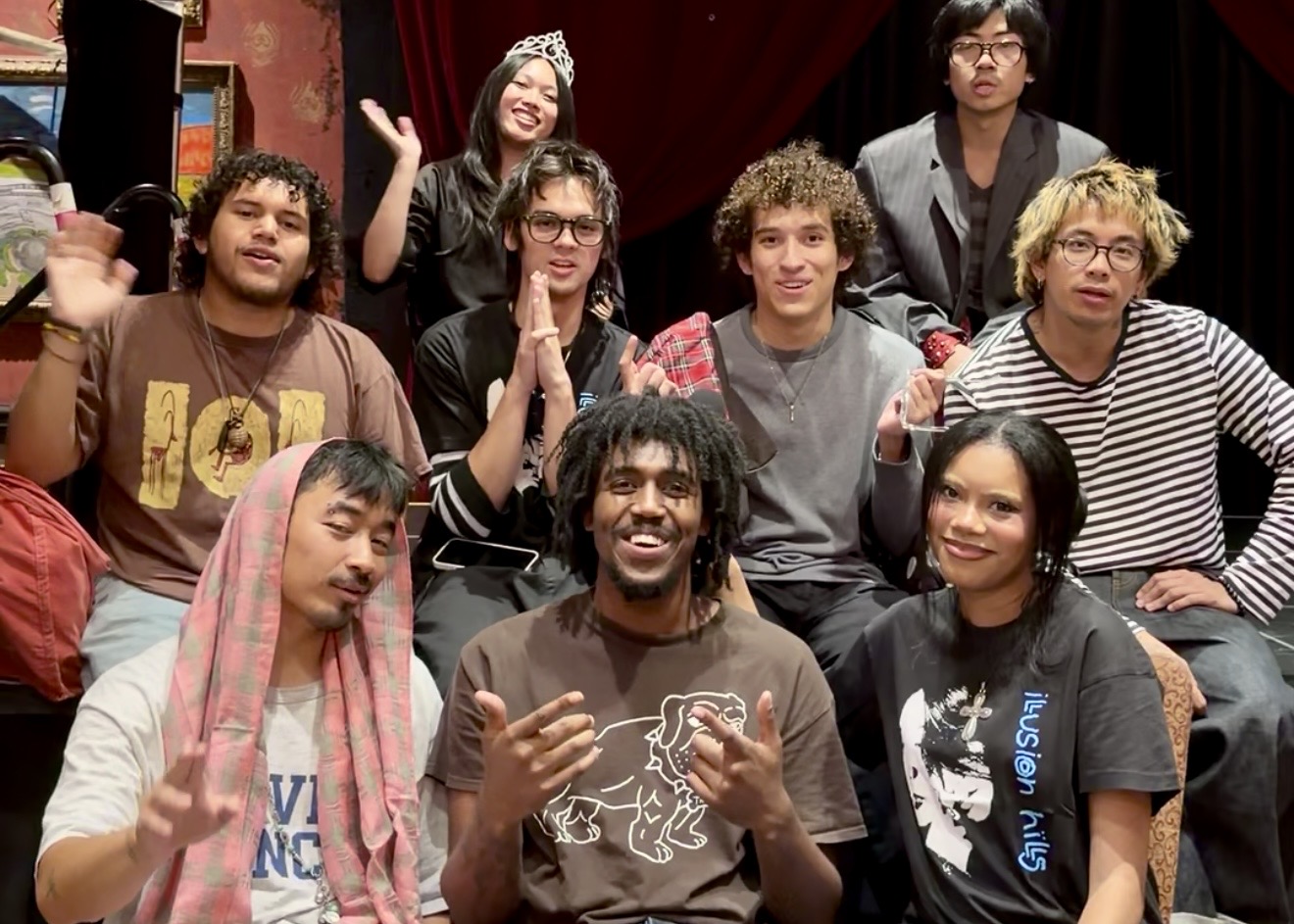
It’s busy backstage with Illusion Hills. They just finished performing, opening for Laundry Day and giving one of the most electric and engaging performances I’d seen in a long time. There’s no time to waste as they begin packing up their equipment, assuring me it’s fine to begin my questions while they multitask. They’re a long way from home, which is the Los Angeles area. The 12-piece collective has been releasing music since 2020 and steadily putting on more local shows. Joining Laundry Day on their Larger Than Life tour is a new feat for them, the first time they’ve toured and performed on such a scale. They’re no strangers to a challenge, though, having released two albums.
The Illusion Hills Timeline
The current Illusion Hills lineup consists of MJ, Armin, Salad, Sai, Braeden, Brandon, Alyssa, Mikey, David, Alex, Pada and Freddie. Notably, they include their visual collaborators (Brandon and Alyssa), who direct their music videos and handle photography, as well as their managers and editor (Alex, Freddie and Pada) as part of the collective. It’s refreshing to see, and a reminder that the output of Illusion Hills is made possible not just by their vocal and producing members, but by the work of everyone in the collective as a whole.
MB: Tell me about how you guys met and the origin stories of Illusion Hills.
There’s a commotion at the question, and they give me the rundown on how each member came to be part of the group. Illusion Hills started in 2020 with MJ and Sai, who attended the same high school. Sai was making SoundCloud music at the time and would send songs to MJ, who told him he was a fan. From there, MJ would send him beats as well, and they began hanging out and creating together. Brandon was the first visual member to join back then in 2020, helping direct their earliest music videos; Pada helped with editing as well.
MJ: I had a ton of talented friends, and I hated making music by myself in a way. I always thought it was so much more fun to make with my friends. We kind of slowly built out a team, and we’ve had so many different members come and go, and now I think we’re at a place where it feels very concrete and like this is us, this is what Illusion Hills is really meant to be. That can always change, honestly. I think I said that same thing before Mikey came, and then Mikey came, and it was just like, yo, we have to keep this kid around us.
A lot of the members who joined later mention discovering Illusion Hills online. If you’re into music, you’ve definitely seen the name Illusion Hills on various TikTok posts. The members have a knack for the internet, so much so that their marketing prowess led to the collective having the lineup it does today. Their Discord server is also essential to their story, with friendships developing on the platform that led to collaboration and eventually invitations to join the group.
Salad: They were already a formed band. I got an Instagram ad for Pilot 001, our 1st song on Spotify. I joined the Discord, and we would talk a lot, and we all got really close. I’d be on calls with Pada separately. I’d be on calls with MJ and Sai a lot, legit like two in the morning. We’d be in class just on Discord, all chopping it up; we’d have our cameras off and just chat. I joined as a graphic designer because their graphic designer and photographer left. When I first went to LA, I started doing vocals because they saw that I could rap a little bit. I joined in 2021 just as a graphic designer, and in 2024, I started doing vocals. The rest is history.
Their second visual-focused member, Alyssa, joined the group in 2022 after initially interviewing them for a music blog piece.
Alyssa: I was working for a music blog at the time, and I reached out to them for an article. I put them all in a chat, and I don’t know how, but they all got somehow really comfortable with me. They started sending a bunch of pictures and memes while they were in class. Then they invited me to their first show, and they were like, “We need a new photographer.” I didn’t really do photography too much at the time... but here I am. And I’ve been with them since then.
Braeden, who joined next in 2024, was already forging his own path releasing music solo. Still, he was in the Illusion Hills orbit, living in the same area and sharing a few mutual friends. It wasn’t until he opened for them at a show in OC that fate unfolded.
Braeden: I met them almost 5 years ago. It’s funny because I lived near MJ, Sai, Pada, and Brandon my whole life, and we had mutual friends, but we never crossed paths. Then we had this one show in OC. They were headlining, and I was actually opening by myself. I met them at this show; we became really, really good friends. I was around for a little bit, moved in with MJ, Sai, and Freddie. A year after living with them, I was already making a bunch of music with them. At that point, I didn’t know what I was doing [solo], and MJ kind of brought me back into that inspired mindset, and he kind of pushed me. We’re already making a bunch of songs, and he just asked me, “Hey, do you want to join?” And I said, yeah, and here we are.
Armin, who handles production and guitar alongside MJ, has a similar story of finding them through the internet first.
Armin: I met these guys when they were already doing music in 2021. I got a TikTok ad from them, and then I was like, oh, I fuck with these guys’ vibe; let me like join their Discord in hopes to one day produce with them. As time passed by, I got closer with MJ and Sai and all the other guys. We would make music here and there; MJ and MJ would make beats together and exchange them. It wasn’t until the beginning of 2025 that I officially joined the band.
Mikey is one of the latest additions to the collective, only joining officially in May 2026. He had a similar experience of finding Illusion Hills from a video they’d posted on TikTok, then recognizing them at an event his friends were performing at. He introduced himself, slowly started going to more of their events, and became close with the members. That closeness led to an invitation to work merch for them and eventually to run sound at their UC Irvine show. Things were solidified by a recent San Francisco trip the group took.
Mikey: The friendship started to build and develop until the San Francisco trip. It was just such good energy, and I think we clicked, and I think that trip really solidified a lot for me because it was all of us together. These guys are so tight-knit that I feel like that was almost like a test, even if they didn’t openly say that or anything, but at least spiritually, it could have been that. We were able to coexist and build a good relationship, the foundation for something like this. Eventually, I was around so much; these guys were like: do you want to start doing shows with us? Do you wanna help us out on stage, run sound, learn the ins and outs of this? I had always made music, but never performed it or anything. So it’s just super new to me. The opportunity was so crazy. Now we’re here, and now we’re touring and getting to live this together, experience it together. These guys are genuinely my brothers, and I don’t say that lightly. These guys are like my backbone, my foundation. Some people may doubt it because of the recency of our relationship, but there are just some things that you live together and experience together that you just don’t have with anybody else in the world, and I’m super happy and grateful to be a part of this.
On Being a Collective
A recurring theme during the interview is a member excitedly interjecting here and there, or sometimes hanging back and waiting to add their answer. It happens constantly as we get into what the collective means to them.
MB: What does it mean to you to be a collective making music and to have people that play different types of creative roles?
Salad: It’s like a creative fraternity, to be honest. A good one, though. The best fraternity ever. These are all people who I will always love with all of my heart. We’re such a tight-knit family, and it’s really awesome. It’s really heartwarming for me because not only is it a creative outlet; anyone can have a creative outlet- it’s like an emotional one too. I could talk to anybody here about anything that’s going on in my life, and they’ll sit down and listen to me, give me advice, etc. I’m super grateful always.
Mikey: The layers of a collective, there’s so many issues that you could run into, and I don’t think that there are issues we run into very often. I think there’s so much overlap with how we discuss our creative output. Armin’s a producer, right? But if Armin says something about the cover, or if he says something about a design, we take that input, and we go with it. We have a quote-unquote role, but we don’t, genuinely. We might have a focus, but we all influence each other in every aspect of everything that we do.
We have a quote-unquote role, but we don’t, genuinely. We might have a focus, but we all influence each other in every aspect of everything that we do.
MB: You guys have been a group for a while. What do you think has been one of the biggest lessons you’ve learned about working together and making art together?
MJ: I think usually friends tend to become different people over time, and you start to drift apart and become different. It’s learning to trust our differences. In the beginning, it was less about being a perfectionist about everything, and everyone was down for whatever because we’re doing this fun thing; it’s fresh, and we’re just kind of like, go, go, go, go, go. Like, oh, you have an idea- let’s fucking do it. That was the way we started, and now we’re at a point where everyone feels very strongly about what they’re doing. I think it’s easy to get onto different pages, and it’s about learning how to find the same page again over and over and over again. It’s about creating a healthy environment that everyone loves being around, even though that may seem impossible.
Brandon: When there are so many people in a group, sometimes you feel like you could be losing your voice. If something is being made, you’re receiving a lot of people giving new ideas. It feels like you’re losing your voice sometimes. It’s trying to find your voice in the part of the idea of whatever you are doing, even though it’s not 100%. Whatever you get, whatever you get the chance to do, you just put all your effort into that and make your job or what you can bring to the team as much of yours as possible. I think a really good way to think about it is almost like a 10-part harmony where every note is super essential to making it sound and come out the way you want. Even if you’re tucked in the back and you might feel like you’re not heard, if you’re not there, then it falls apart. For example, speaking musically, you might not always get the biggest part. Even if you wanted to do a longer verse, or you wanted a hook. Your part is still essential. You are there because you’re needed. I think that’s like an important thing to constantly remind yourself of: you wouldn’t be here if we didn’t need you. You wouldn’t be here if we didn’t want you there. There might be a moment where your impact might not be as big, but there’s gonna be a moment where your impact is the biggest. That’s something that I had to learn; sometimes it’s not as personal as we make it.
Sai: I would probably say just trusting the process and not having an ego. I think that’s the biggest thing because obviously all of us want to be a superstar. We all are gonna be superstars. So, I think just not having an ego and just communicating with each other; communication is key. We’re a family at the end of the day. We love each other unconditionally. We friends before this music stuff.
Braeden: I think it was definitely an adjustment period. I’ve had a history of working with other people, and I was making music by myself for probably like 3 years before I started collaborating with people in terms of a whole group. Never done anything like that; usually it would be one person, 2 people. I think the most important thing is never, never say no to an idea without seeing it through. Ego’s a big one, like Sai just said. That was huge. It’s so funny because there’s so many of us. Not just the vocal members talking about it and debating; it’s also the video team, the management team. Everyone has a say in what we do in the music, and I think that’s the most beautiful thing out of all of it.
The idea of members with different roles offering creative input across the board is part of what makes Illusion Hills such an interesting collective. I wanted to hear more from the visual members about how that philosophy plays out for them.
MB: You’re dealing with being in a musical group; how do you think your creative input plays a role? What are the dynamics of that for you guys?
Brandon recounts how living in Syracuse shaped the way he approaches visual storytelling as a director. He was sent a new song at one point and wasn’t sure how to connect with it or translate it visually. Then he traveled to LA and saw them perform the song for him, the way they sang it and the emotion conveyed at certain parts, and everything clicked: the parts of the song they wanted to hit, where they were getting more emotional.
Brandon: Video in general, you’re putting the face to the music. That’s such an important thing. For videos, I realize that whatever video we’re making, it’s my job to communicate what this song would be through a means of not just shooting them, but to find the deepest points. Sometimes even in something that they didn’t see in the song themselves.
Alyssa: Working with these guys, they make it easy. It almost makes me feel like I’m a part of the music too. I think we all also are in a hybrid type of space. We all bounce ideas off of one another anyway. We give input both ways. So, the visuals will also give input on the music. We all work collectively, and we all kind of have the same vision, essentially.
Salad: Me and Alyssa do a lot of work together. That is absolutely my dog for life. As I’ve started to do both (vocals and design), I want to make them a lot more connected. Before, I was making cover art based on what the song felt like, what I envisioned when I saw it or when I heard it immediately, what I first saw. Now it’s a lot more of like, okay, how can we contribute to the story that we’re already telling? Through our graphics. Before, it was just a lot of like, okay, this looks cool. I wouldn’t say any of the stuff from before is bad, but I think now it’s a lot more cohesive and resonant with the music because I am, I’m kind of like a bridge in that sense. I think all of us work together very well on working on designs, videos, photos, and just what we want to represent alongside what we’re making sonically.
[two]
MB: Could you tell me more about your upcoming album [two]?
Salad: The best way to think about it is to think of people that you love in your life. [two] is very much an album about relationships, but what it’s like to coexist between two people; hence the name, that’s part of the name. Expect a very different sound, but a very cohesive sound from us. I think we have a lot of variety on this project. I would say it’s our most cohesive project to date. There’s a ton of palatability to it while also making sure that we stay true to ourselves and how we want to make music, how we want to experiment.
Salad shares an interesting tidbit about the release: the visual world of [two] is based on neo-classical paintings about romance. Each painting they chose to emulate was picked based on what the specific song was talking about, what the piece represents, and their own interpretation of it.
Mikey listens in and adds on after Salad.
Mikey: It’s been going through a bunch of phases; I’ve heard so many different versions of the songs. Everybody, everybody has a pen, and everybody’s getting down there, putting in the work, doing what we have to do to get this project out. We’re excited; we’re playing some of the songs that are gonna be on the project during our live set right now on tour with Laundry Day. Shout out to Laundry Day. The crowd is super receptive to the new stuff. There’s no shifting energy from when we play the hits versus the new stuff, which is sick, you know?
Everybody, everybody has a pen, and everybody’s getting down there, putting in the work, doing what we have to do to get this project out.
MB: What was the approach like for this new release? And would you say it was different from when you worked on [one]?
MJ: I would say very different because with [one], we were pushing to get it done in a certain amount of time. This project took a lot longer for us to finally be in a place where we think we can put this out there. We wanted to put it out back in December of 2025. It’s a really long time coming, and we got a lot of time to keep working on it. So definitely different iterations of the project, versus [one], it was kind of very much like, oh, we made all these songs in a certain amount of time.
MB: What would you say were your biggest influences while working on the project?
Sai: A little bit of Kanye West, a little bit of Chanel Beads, for sure. Especially with MJ as well, with the production side of it. I would also say we influence each other; we have a big influence on each other, and we push each other to be better than what we already are.
Armin: As far as a production/guitar standpoint, me and MJ are influenced by a lot of dream pop/shoegaze kind of stuff. Cocteau Twins, My Bloody Valentine, Slowdive, just essential stuff.
With their first tour as an opener wrapping up and the release of [two] on the horizon, it’s clear that Illusion Hills are entering a new era. It’s an era forged from their 2020 high school origins and made possible by the contributions of every member they’ve added since. The collective and their releases bring about more than just music: a real lesson in teamwork and what it can bring to creativity.

Comments
Loading comments…