

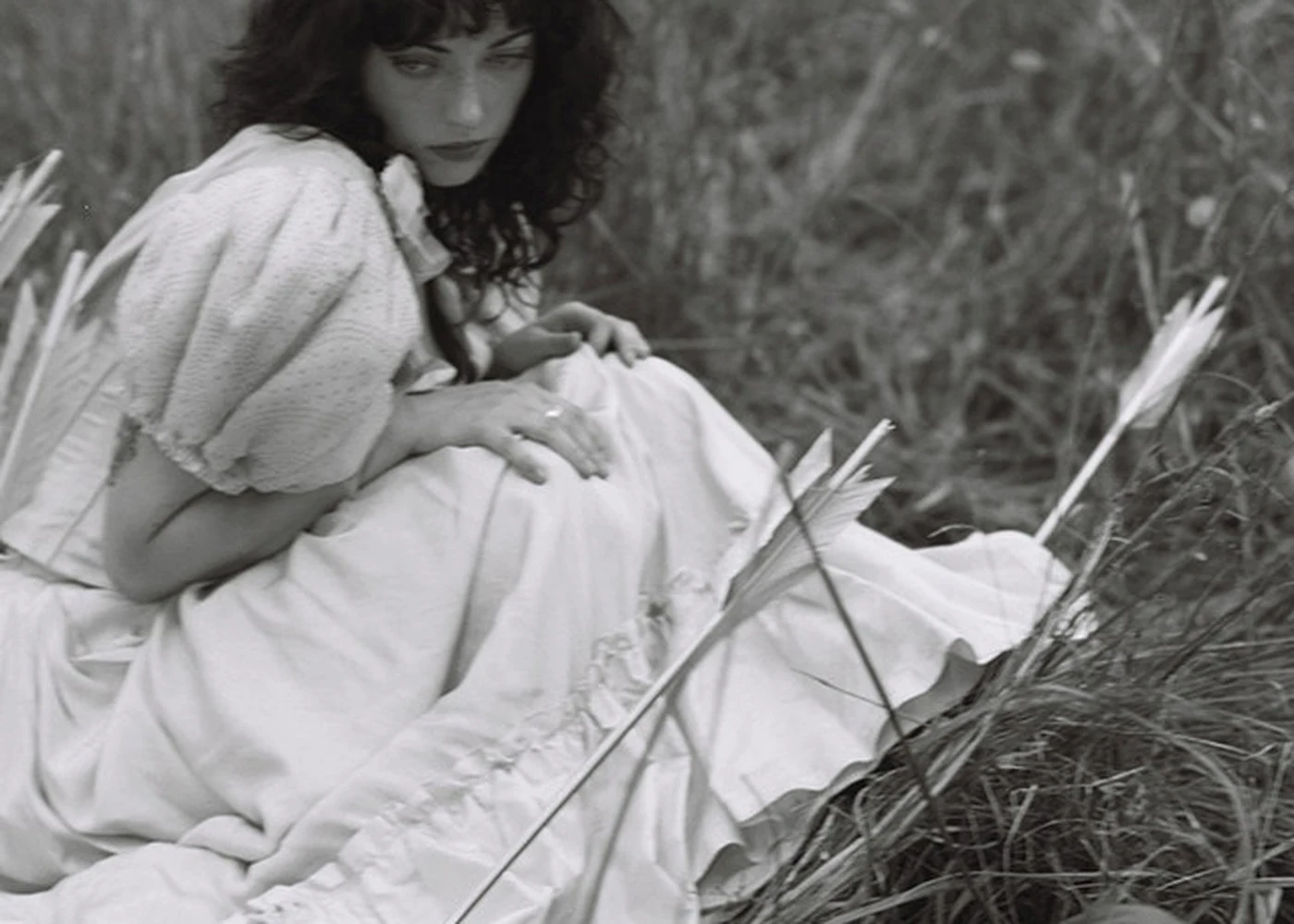
You know the hour this song lives in: the house has gone still after the funeral, everyone who came to help has gone home, and you are lying awake wishing tomorrow would be brief. "Metal Birds" keeps you in that hour and never lets you climb out. Its narrator has just laid flowers on someone's chest. Everything they ask for afterward is a way to survive grief without facing it whole: rescue from the sky, a sunrise that lasts only two days, a promise to forget. The song treats hope as something you rent in small, returnable amounts, because owning it outright would mean admitting the loss is permanent.
Asking the machines to carry you off
People have prayed to birds for as long as there have been songs, but this narrator looks up and sees something colder crossing the sky.
"Metal birds in the sky / Come and take me away"
The lyric never calls them planes, yet they are the only things moving overhead that could carry a person anywhere, and the narrator doesn't ask for wings of their own. They ask to be collected, like cargo, by something that feels nothing about the trip. Then comes the strangest instruction in the song, "Generate our power breaker," which asks someone to build the very switch that cuts the current, as if the narrator wants a manufactured off button for whatever is still running inside them. "Look at me through the embers" finishes the picture, with a face seen through what's left of a fire. The fire is already out.
Death at the neck, flowers on the chest
The chorus is where the song tells you who is leaving and who is left, and it does so through gestures rather than statements. The narrator kisses someone while smiling, wears death around their neck, sleeps for a while, and then lays flowers on that person's chest. That last image belongs to the living. You lay flowers over someone lying still, and you only do it if you are the one who has to keep standing.
"Kiss you with a smile / Death hung around my neck"
The death at the neck could be a pendant, a keepsake you can't take off, or it could be a rope, and the lyric refuses to choose. I read it as a pendant: grief worn as jewelry, close to the throat, impossible to forget it's there. A reasonable fan could read the opposite way, with the narrator as the condemned one and the flowers as a final goodbye from someone about to go, and on an album titled Sunrise on the Reaping that reading has real teeth. But the future tense in "I'll lay the flowers" puts the narrator above the body, and the song keeps them there.
Then the chorus hands out jobs.
"Open eyes are for the weeping / Let the sun rise just for the weekend"
The line I keep coming back to is the first half, because it explains why the narrator keeps drifting toward sleep. If open eyes exist to weep, then closing them is the only break available, and "sleeping for a while" becomes both a soft word for the dead and the narrator's own escape hatch. The second half is even sadder. Dawn gets booked like a short getaway, two days and then gone, which makes sense for someone who can't imagine a full week of mornings without the person under the flowers. The sun, presumably, gets the rest of the week off. Hope comes with a checkout time.
A feather headed for the old paradise
The second verse sends a silver feather floating through the mountains toward "my old paradise," and that feather can only be something shed by the metal birds, a piece falling off the rescue before it ever arrives. It flies through the mountain rather than over it, which feels less like flight and more like burrowing back into the past. "There you can see what I'm after," the narrator says, pointing at the thing they want most. They never name it.
The promise, and the fall that never lands
For the whole song the narrator has been talking to birds, embers, the sun, and a body. Then, after the final chorus, they finally turn to a person and ask for something plainly.
"Promise me, I won't remember / Through the blinds, a road to nowhere"
The request is impossible on its face, because nobody can promise what goes on inside your own memory, and if the "you" is the one lying under the flowers, the narrator is asking the dead to guarantee their forgetting. That is the real wish under all the flight imagery. They want amnesia, and they want someone else to be responsible for granting it.
Everything after the promise drops. The sky is gone, and the narrator is indoors, looking through blinds that slice the view into strips, at a road that leads nowhere. The escape fantasy of the opening has shrunk to a window and a dead end. Then "Even when it comes down" arrives, followed by "comes down" twice more, and the song never tells you what "it" is. Rain, a bird, the sun at the end of its weekend, a blade: all of them fit, and the repetition keeps falling without ever hitting the ground. Nothing gets resolved.
Conclusion
We started in that sleepless hour after a funeral, and the song leaves you exactly there, which is its most honest move. The narrator asks for rescue, for a rationed dawn, for permission to forget, and gets none of it, only blinds and a road and something descending in the dark. I hear the whole song as the sound of someone negotiating with grief over terms, trying to lease a little light without signing up for the long haul of healing. They asked the sky to take them away, and the sky's only answer is that something keeps coming down.
Frequently Asked Questions
What is "Metal Birds" by Violet Grohl about?
"Metal Birds" follows a narrator mourning someone they have just laid flowers on. They beg machines in the sky to carry them away, ask for a sunrise that lasts only a weekend, and plead for a promise that they won't remember. It is a song about wanting to escape grief rather than move through it.
What does "Let the sun rise just for the weekend" mean in "Metal Birds"?
The line treats dawn like a short getaway that can be booked for two days. The narrator can only handle hope in a limited dose, because a full week of normal mornings would mean accepting that the loss is permanent. On an album called Sunrise on the Reaping, the sunrise here is rationed.
What does "Promise me, I won't remember" mean at the end of "Metal Birds"?
It is the narrator's first direct request to another person, and it asks for something no one else can give: control over their own memory. After it, the song moves indoors to a view through blinds of "a road to nowhere," and the escape fantasy collapses. The closing "comes down" repeats without ever landing, leaving the narrator suspended.
Lyric analysis powered by Scalpel.


Comments
Loading comments…