

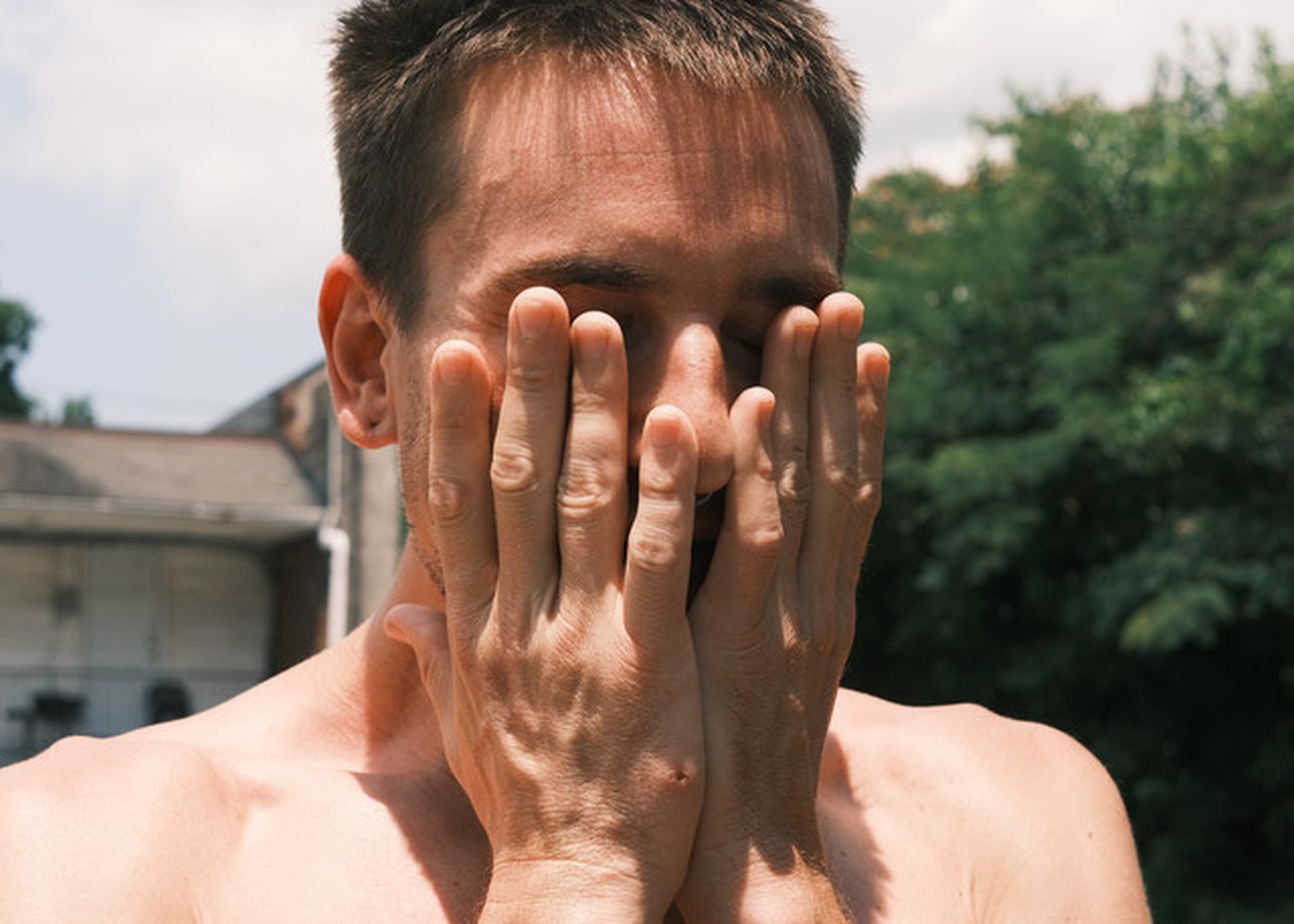
"If I take my armor off, would you put that blade through my side?"
That question is the whole song. Every verse before it is the narrator building the case for why the armor stays on, and that final line is the only moment the real fear gets named: not that love will fail, but that vulnerability will be punished. The armor was never about strength. It is a preemptive flinch.
The Collapse That Starts Everything
The first verse tumbles forward in a kind of controlled free-fall. Control drops away fast. "We think we're in control 'til we're not / Then we're helpless." The slide from "we" to "helpless" happens in a single breath, and the big empty just fills the space that confidence left behind.
What follows is a list of avoidances. No money, no phone, no messages. Then:
"I wanna starve myself until I'm beautiful / Hey, what the fuck is that?"
The self-interruption is the most honest move in the whole song. The narrator catches himself mid-spiral and acknowledges the thought is ugly without flinching from it. That "hey, what the fuck is that" is not a repudiation. It is more like looking at your own hand and not recognizing it.
Then Paul's philosopher drops in: "Hope is fear and fear is hope." The narrator takes that and stretches it into Sisyphus, casting the person he loves as the boulder. That mythologizing impulse is important. He is already turning the pain into something. Not art yet. But something.
The Chorus and the Trick It Names
The chorus does something unusual for a song with this much self-loathing in it. It admits the mechanism while doing the thing.
"And I hate myself, so I turn it into art / Or something dumb, put my armor on"
"Or something dumb" is the tell. The narrator knows the conversion of pain into art is a defense, not a resolution. He knows the armor is a wall. He says so, then puts it on anyway. The self-awareness does not liberate him. It just narrates the trap in real time.
That is the song's central argument: knowing exactly what you are doing wrong is not the same as stopping.
Verse 2: Hell and the Plane Going Down
The second verse is the darkest stretch and deserves to be held carefully. The truck-in-the-gutter image opens it, that familiar pattern of ignoring a problem until the whole thing fails. Then:
"I'm on a plane kinda hoping that it goes down / I bet there's gotta be a peace that you get / When you finally know the ride's gonna end"
This is passive, exhausted ideation, not rage. The narrator is not reaching for an exit. He is daydreaming about relief. The peace he imagines is not death exactly, but the end of the uncertainty, the end of the not-knowing when the weight lifts. It is the feeling of a man so worn down by his own mental weather that stillness starts looking beautiful no matter what form it takes.
The Hell question sits right before it. "If Hell is real, how do I know for sure / I ain't living in it already right damn now?" He is not being dramatic. He is asking a genuine theological question from inside genuine suffering.
Verse 3: Where the Definitions Break Open
The third verse is where the song earns everything it spent.
"Okay, I guess we just go until we die" lands with the exhausted acceptance of someone who has been through the spiral enough times to know it does not resolve, only continues. The shift drink, the dancing down the starting line: the narrator is just moving again, which is its own kind of grace.
Then the definitions start piling up:
"Time is love, what I'm scared of is an empty mouth / Love is time, love is looking for your keys in the couch"
The line I keep coming back to is the keys in the couch. Love here lands on the ordinary friction of a shared life, someone who knows where you left them, someone who has seen the mess. And after all that circling and theorizing, the narrator lands on something physical and specific. That is the thing he actually wants and actually fears losing.
The definitions keep cycling, love is time is pride, until the last line closes the loop: the armor question. Now the reader understands what the armor is protecting. Not ego. The fear that intimacy is a gamble where the other person might, once the walls come down, decide to use what they know.
The Bridge: Dispatch
The bridge confirms the pattern without adding new information. "I build a wall, baby, brick by brick" names the metaphor plainly, and "something's gotta take a break here quick" is the closest the narrator comes to asking for help. It is an admission without a request, which is very on-brand.
What the Armor Is Actually Protecting
"Armor" is not a self-pity record. The narrator is too clear-eyed about his own machinery for that. What makes the song ache is that the self-awareness is real and the armor stays on anyway. He knows the projection, he names the art-as-deflection, he clocks the Sisyphean loop. None of it moves him.
A fair counter-reading says this is ultimately a love song in disguise, that all the self-laceration is the narrator's way of saying "If I take my armor off, would you put that blade through my side?" There is room for that. The final question could be read as an invitation as much as a fear.
But the more honest read is that the armor wins. The song ends with the chorus unchanged, the armor back on, no one let through. The shift drink and the dancing are momentum, not healing. And the question about the blade stays a question. The narrator never gets an answer because he never takes the armor off long enough to find out.
Lyric analysis powered by Scalpel.


Comments
Loading comments…