

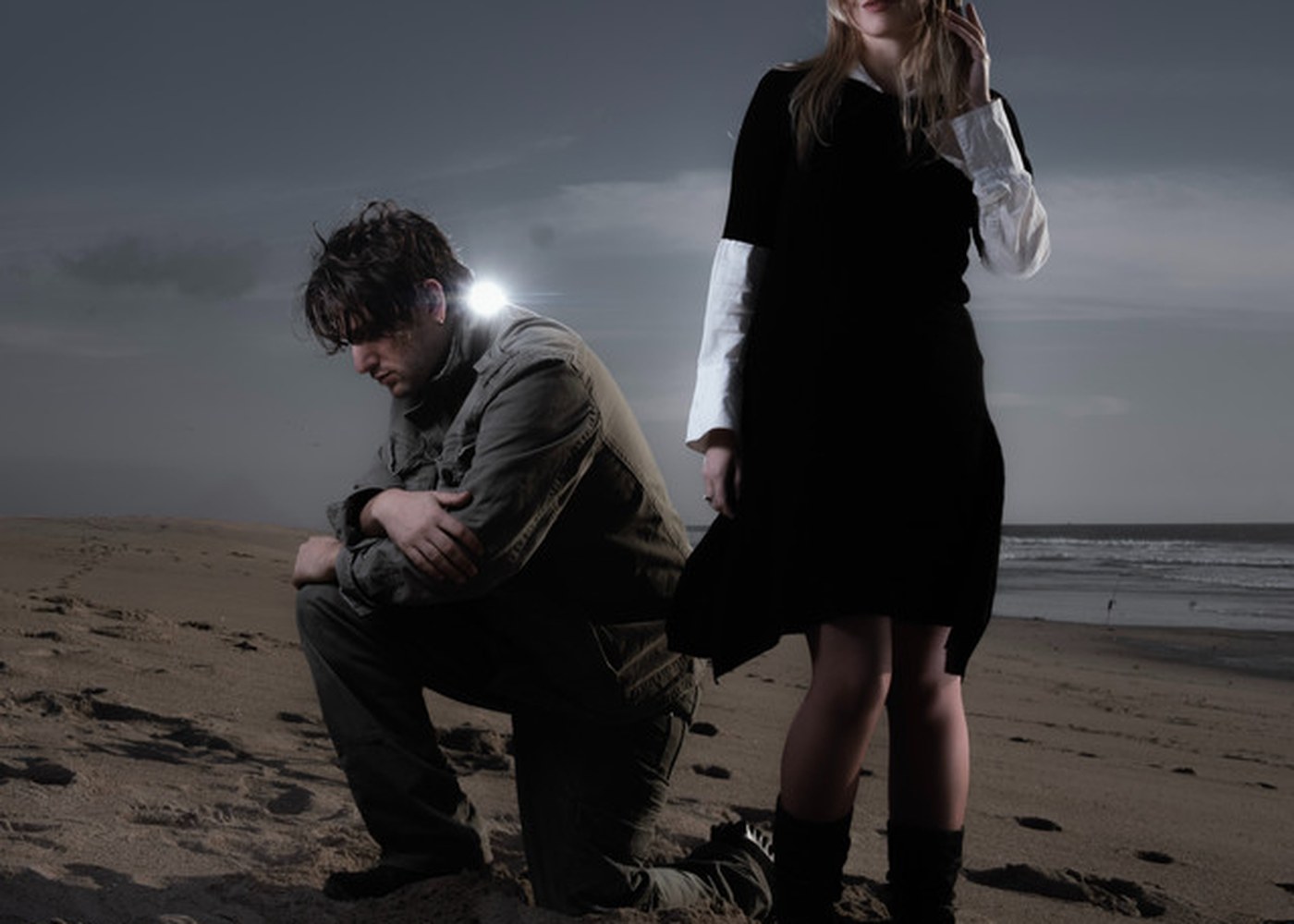
Most songs about prophecy want you to fear the oracle. This one kneels in front of her and asks for something she has never once been able to give. The Cassandra myth is usually told from the outside, about the tragedy of not being believed. After's "Blind" flips the angle entirely: the narrator believes her completely, and that belief is precisely what makes the devastation total.
The Inventory of Depletion
The song opens not with a crisis but with an accounting. Verse by verse, the narrator lists what has been taken or surrendered, and the grammar of that listing matters enormously. The speaker describes the aftermath of grief, the hollow place where the feeling used to be.
That structure borrows from elegy but strips out the lamentation. There's no reaching back for what was lost. Each line closes a door with the same flat finality, until the whole first half of the song reads like someone emptying their pockets before stepping off a ledge.
What makes this opening unusual is that the narrator doesn't assign blame with any heat. The flatness is the emotional texture the rest of the song has to fill.
Cassandra and the Trap the Myth Sets
The chorus arrives as a prayer, and it's the cruelest kind: one sent to someone who was cursed specifically to be useless.
Apollo's curse on Cassandra was not that she would be wrong. It was that she would be right, always, and never believed. But the song doesn't invoke her as a figure of frustrated truth-telling. It invokes her as a figure of foreknowledge paired with impotence. The narrator knows she sees what's coming. The narrator also knows she cannot intervene. And the narrator asks anyway.
That request is where the song's argument lives. Asking Cassandra for help isn't delusion. It's the act of someone who has exhausted every realistic option and turned, finally, to the one figure who shares the same fixed relation to fate: the witness who cannot change the outcome. The narrator and Cassandra are symmetrical. She sees the future and cannot alter it. The speaker sees the ruin of their own life and seems equally unable to redirect it. The prayer is one powerless figure calling out to another.
The Second Verse and the Logic of Removal
The second verse shifts the grammar and the shift does real work. "Out of" implies exhaustion, a reservoir emptied by use or theft. "Without" implies a more fundamental absence, a state of being in which the thing was never going to be restored.
The line I keep returning to is "extrasensory deprivation." It closes the second verse, and it's doing something strange. Sensory deprivation removes ordinary input, isolating the mind from the physical world. Extrasensory deprivation, by the song's own logic, would be the removal of something beyond ordinary sense, perhaps intuition, foresight, the capacity to feel consequence before it lands. The narrator has lost whatever antenna once warned them. Which is exactly why they need Cassandra. She still has hers.
And there's a dark irony folded into this: the narrator has already closed off the rational channels, the talking cures, the language-based redemptions. What remains is chemical, which is to say temporary and structurally incapable of touching the problem.
The Bridge and the Foreclosure
Brief. Absolute.
The bridge is addressed to Cassandra directly, and it removes the last residual hope the chorus might have carried. The chorus asks for help. The bridge answers the question the chorus was too desperate to finish asking. Nothing can be changed. The knowledge is indelible. The speaker arrives at this not as new information but as something being said aloud for the first time, a way of finally accepting the architecture of their situation.
But the chorus returns anyway, again and again, the petition outlasting the acknowledgment that it can't work. That repetition is the song's most honest gesture. Knowing something is hopeless and stopping the behavior are not the same thing. The song doesn't pretend they are.
What the Song Ultimately Holds
"Blind" is a song about the gap between understanding and agency, the condition of seeing your own destruction clearly and being unable to use that clarity as an instrument of survival. It finds its myth in Cassandra not for gothic decoration but because the myth encodes exactly the right trap: truth without efficacy, knowledge without power, sight without motion.
A fair counter-reading would locate the Cassandra figure not as an external presence but as a part of the narrator's own psyche, the part that already knows what's coming and can only watch. That reading holds, and it makes the final repeated invocation even more interior and desolate than it already sounds.
What the song refuses to do is offer the narrator, or the listener, any exit. The depletion catalogued in the first verses is complete. The myth invoked in the chorus is structurally closed. All that remains is the asking, which by the end has stopped being a question and started being a ritual. Cassandra cannot help. The narrator knows this. They ask her name one more time anyway, because in a world where all the realistic options are gone, at least the asking proves something still remains.
Lyric analysis powered by Scalpel.




Comments
Loading comments…