

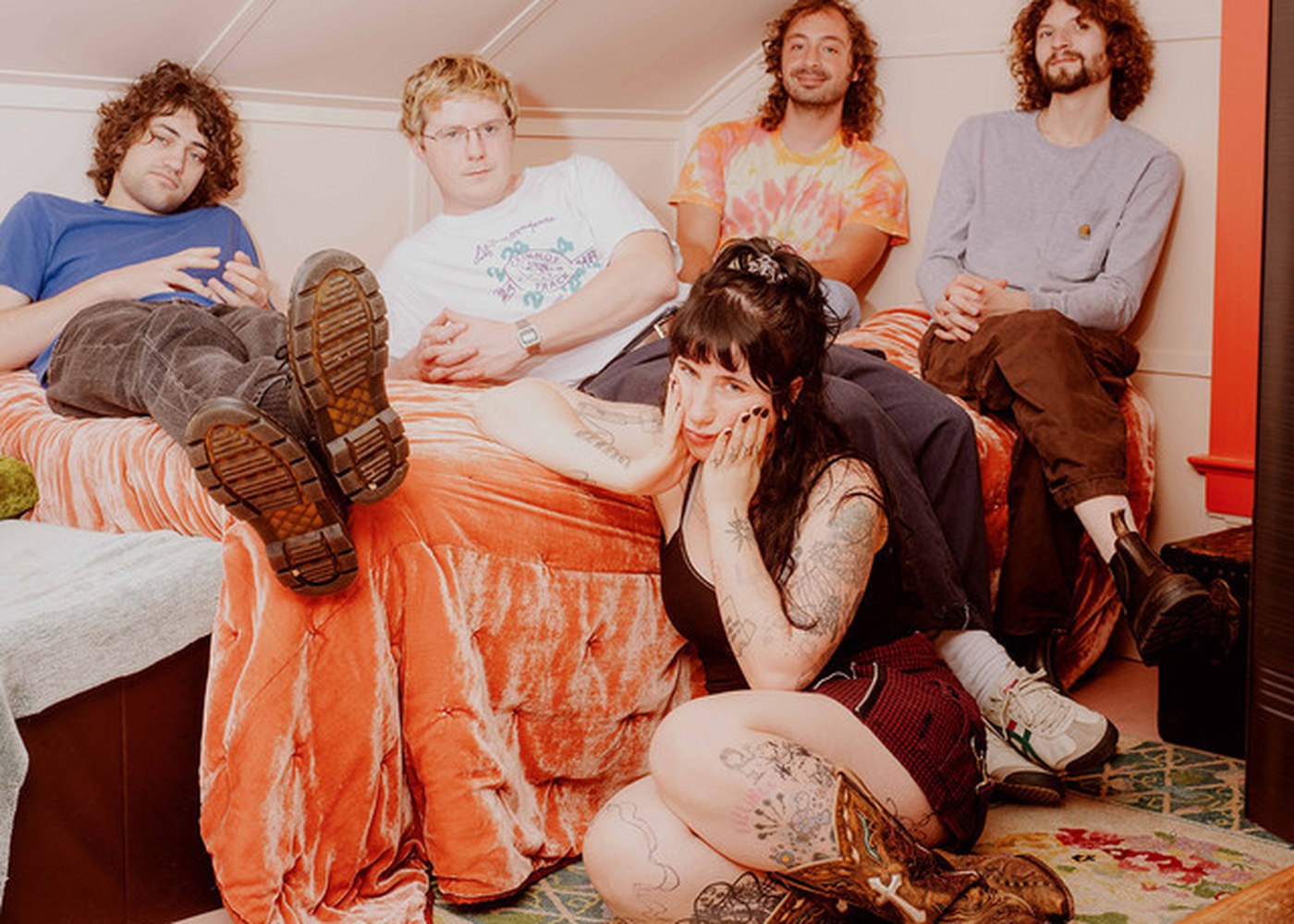
Wednesday's "Wound Up Here (By Holdin On)" walks through a town after a boy drowns in the creek. His dirty jersey goes in a trophy case, friends drink cheap wine at a dead-end on-ramp, and a wake comes with vending machine snacks. Holding on is what strands everyone, and by the antler verse the song counts every keeper of relics, narrator included, among the killers.
Introduction
Try to get misty at this song and watch it trip you on the way down. The drowned kid arrives stapled to a scratch-off ticket, the friends drink 20/20 on a highway that goes nowhere, and somebody's pitbull puppy is pissing off a balcony, so you end up half laughing at a funeral and feeling lousy about it. That queasy mix is deliberate, because the song keeps handing you keepsakes of the dead and then, near the end, asks what kind of person keeps them. Its answer is ugly: holding on is how everyone got stuck here, and the people who hold on hardest start to look like the ones who did the killing.
Verse 1: a dead boy under glass
The first line welds school to gambling before anybody has died. A "scratch-off ticket for the education lottery" is the kind of thing you buy at the register with a pack of gum, and the money is supposed to build classrooms, so the town's future is funded by people hoping to get lucky. Then the body.
"Found him drowned in the creek, face was puffy"
"Puffy" is a coroner's word, or the word a kid uses after overhearing a coroner, dropped flat into a line that rhymes with "lottery" like it's a jingle. The shock comes out almost funny, and that flatness is honest about how news like this actually travels through a small town, between the gas pump and the parking lot.
What the town does next tells you everything. They hang his jersey in a trophy case, still dirty, next to a photo of his girlfriend wearing her "varsity face," which turns a drowned boy into a display piece filed alongside the homecoming pictures. The school sorts his death the way it sorts a district title. Nobody washed the jersey.
The on-ramp to nowhere
The second verse pulls back from the body to the landscape, and the landscape is full of things that were started and left to rot. Somebody "started the highway, then ran out of money," so the on-ramp becomes a hangout instead of an exit, a slab of concrete pointed at a road that was never built, where the narrator and friends meet up to drink fortified wine out of the bottle. Weeds grow through the springs of a trampoline that nobody has jumped on in years.
Hear the chorus against that image and "I wound up here by holdin' on" curdles. Usually holding on is the brave thing, the endurance song, the reason you're still standing; here it means sitting on the on-ramp while everyone else's highway went somewhere. If you're driving home from a hometown funeral with this in your ears, you probably know exactly which slab of concrete it means. The first chorus adds "your faceless fear gathers like a mob," a dread with no single owner that forms crowds the way a town's gossip does.
Then the puppy. "You saw a pitbull puppy pissin' off a balcony" is somebody else's memory, a story the narrator heard and kept anyway, and it sits in the verse like one more object on a shelf. It's a joke and a relic at the same time. Nobody's bouncing.
The wake and the wrong name
After the instrumental break, the song lands at the wake, and the first thing the narrator reports is a mistake.
"Misread your name at the wake"
Misreading a name at a wake means looking at a guestbook, a program, a card on an easel, and getting the dead person wrong. Either the narrator was further from this person than the grief implies, or grief has scrambled the letters, and the song refuses to say which. The line I keep coming back to is this one, because the narrator never flinches or apologizes for the slip; it gets logged in the same voice as the snack that follows.
And the snack is a meal from a vending machine, which is what you eat when the casserole line is in another room and you can't face it. The verse compares the whole thing to "a smack on the ass at the back of a dream," a crude, half-awake jolt, the moment you realize you're standing in a funeral home eating chips. The embarrassment is the realest emotion at this wake. It's also the last thing the song lets you laugh at.
Antlers on a crooked nail
The kitchen comes next, and in it hang "mounted antlers in the kitchen on a crooked nail." Antlers are a trophy, the same word that housed the jersey in verse one, and the crooked nail tells you nobody has fussed over them in a while, which makes them furniture, a dead animal everyone stopped noticing. Then the song makes its move.
"Other killers keep teeth, keep the fingernails"
Everything rides on "other." Calling teeth-and-fingernail collectors "other killers" means whoever hung those antlers already counts as a killer, just one with a more respectable souvenir. Serial killers keep body parts; hunters keep racks; the high school keeps a dead boy's dirty jersey behind glass next to a cheerleader's smile. The song lines these up in a row and won't let you rank them, which is a brutal thing to say about a grieving town and also, I think, the plain logic of the lyric.
Follow the chain one more link and it reaches the narrator. Holding on, in this song, means keeping things: the jersey, the puffy face, the secondhand puppy, a name you read wrong and remember anyway. If keeping relics of the dead is what killers do, then the person who "wound up here by holdin' on" has a shelf of their own. The song never says so out loud, and it doesn't need to, because the chorus has been confessing it the whole time.
A fan could reasonably push back and say the antler line is just gallows comedy, a hunter's kitchen jokingly compared to a slasher's basement, and that holding on stays a hard-won kind of survival. That reading fits the deadpan of the delivery. It can't explain why the song bothers with the word "other," which does the accusing all by itself. The narrator is in the trophy case too.
The last chorus refuses to close
For the final chorus, "your faceless fear gathers like a mob" gets swapped for a single new line.
"You reappear before I noticed you were gone"
The mob finally has a face, and it's one face, coming back before the absence even registered. That's grief working on a loop, the dead returning in a song lyric or a smell or a stretch of unfinished road before you've had time to miss them properly, which means you never finish missing them at all. Whether "you" is the drowned boy, a friend from the on-ramp, or somebody else entirely stays open. It doesn't end.
Conclusion
That half laugh you caught yourself in at the start turns out to be the most honest response available, because the song is about how a town grieves by collecting, and collecting is a little obscene once you look at it under the right light. The jersey, the antlers, the borrowed puppy story, the misread name all stay on display, and the narrator has no plan to take any of them down. "Wound up here" is the confession of someone who kept every relic and got stranded among them, sitting on an on-ramp that was never going anywhere. The cruelest part is that the dead keep reappearing, which means the narrator will keep holding on, which means the shelf keeps filling.
Frequently Asked Questions
What is "Wound Up Here (By Holdin On)" by Wednesday about?
The song moves through a town after a boy drowns in a creek, from his dirty jersey hung in a school trophy case to drinking at an unfinished highway on-ramp to an awkward wake. It treats "holding on" as a way of getting stuck, and it links keeping mementos of the dead to the trophies killers keep.
What does "Other killers keep teeth, keep the fingernails" mean in the song?
The line follows an image of mounted antlers in a kitchen, and the word "other" implies whoever hung them is also a killer keeping a trophy. It connects the antlers back to the drowned boy's jersey in the trophy case, suggesting that anyone who keeps relics of the dead, including the narrator, belongs in the same row.
What does "You reappear before I noticed you were gone" mean?
It replaces the earlier line about a "faceless fear" in the final chorus, giving the dread a single face. The line describes grief that loops, where the lost person keeps returning in memory before the absence can even settle, so mourning never gets to finish.
Lyric analysis powered by Scalpel.

Comments
Loading comments…