

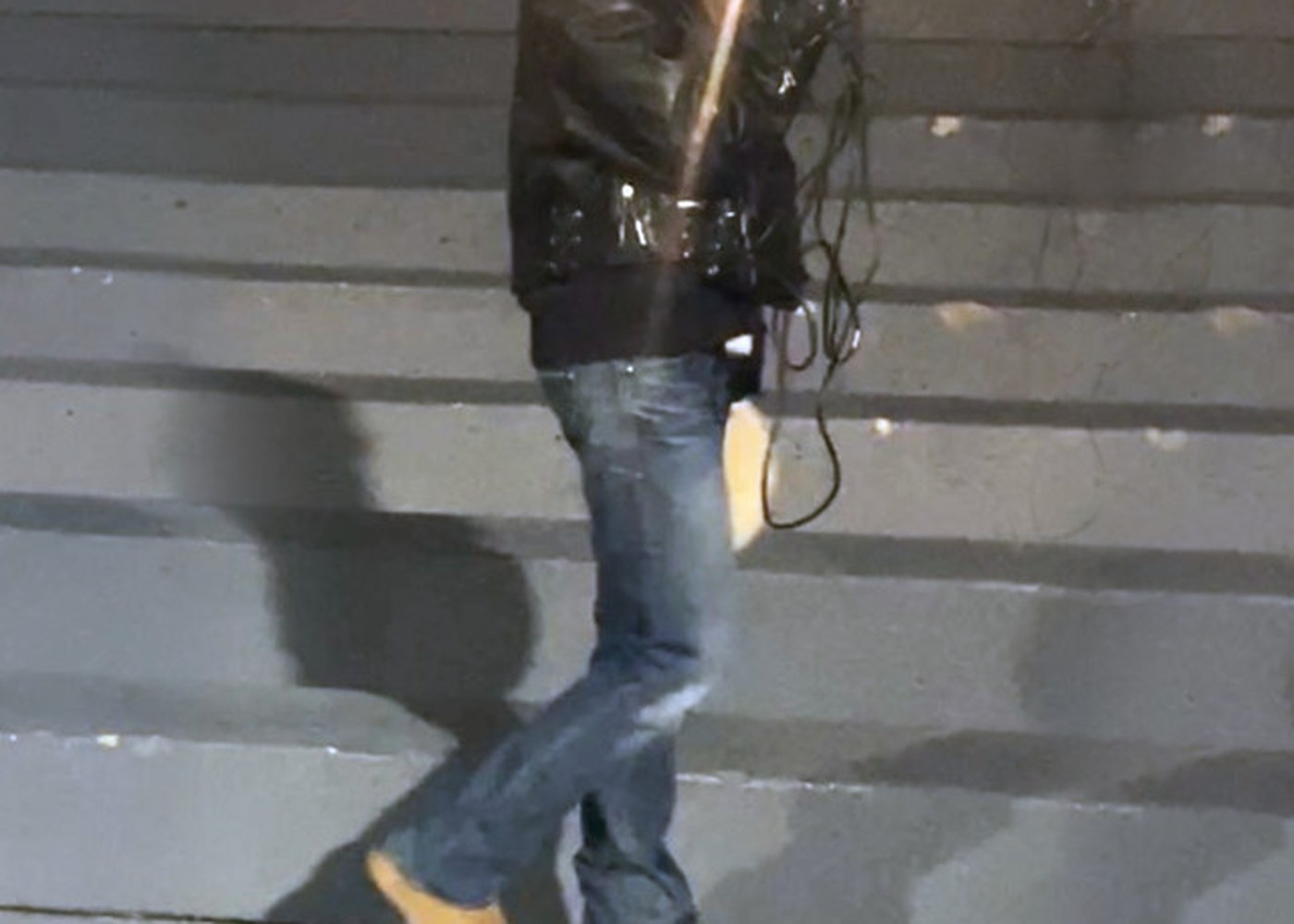
The narrator drives the entire song, hands on the wheel and heel on the gas, and still keeps begging someone to take them to heaven. Both things are true at once, and the song never chooses between them. On the surface it's a late-night crush: a slow loop around the city, a woman caught in the rearview mirror, a sudden swerve toward Queens. Underneath, the song is about envy disguised as desire. The narrator can't tell whether they want this woman or want to become her, and the only confession they ever manage is a question.
A slow car and a face that follows
At first nothing much happens. The narrator has been circling for "a couple hours," a car with no destination, the city turned into a loop instead of a place. Then something "just hit me," and a face shows up.
"Staring through the rearview mirror / It's like she wants me to see her"
A rearview mirror shows what's behind you, and the closest thing behind any driver is the driver. The lyric never puts this woman in a seat. She's there "everywhere I go," which is exactly how a reflection behaves, or a thought you can't shake after a night out. I keep picturing the narrator catching their own eyes at a red light and not quite recognizing them.
"It's like she wants me to see her" gives the game away. Mirrors don't want anything. The narrator is projecting a wish onto glass, and the chorus follows with a request that trails off: "But I want you to know." Know what? The song says it twice and never finishes the sentence.
Love, jealousy, and a dollar's worth of becoming someone else
The second verse is where the narrator tries to describe her, and the description gives them away. "There's something about this chick," they say, then list a cool haircut and "a laugh so free." Those are stranger details. They're what you clock across a bar about someone whose ease you can't stop staring at. You don't fall in love with a haircut. You covet one.
"Maybe it was love / Maybe it was jealousy"
The follow-up, "It's hard to tell the difference these days," comes out as a shrug, but it's the most honest line in the song. The narrator has stopped being able to separate wanting someone from wanting to be them. Then comes the couplet that settles it for me.
"But all you need is a dollar for karaoke / To make you feel like the girl of your dreams"
Look at who gets transformed. Karaoke doesn't bring you closer to the girl of your dreams. It makes you feel like her. The dream girl is a role you step into, with a borrowed voice, for the price of a dollar. That's the tell: the fantasy points inward. It's also funny, and the song knows it. The whole ache of the night costs one bill, and the transformation lasts exactly as long as the song on the screen.
Meanwhile, parenthetical voices keep talking back. "Please don't tell me why" cuts in right after the narrator admits the fascination, as if they'd rather not hear the answer. "There's no one to help you now" arrives between love and jealousy like a verdict. Whose voice is it? It could be the woman's, or some third party's, but it sounds most like the narrator's own harsher self, the one who already knows.
A reasonable fan could hear all of this as plain romantic longing, with "jealousy" as a cover story for a want the narrator can't say out loud. That reading holds up. But the karaoke line keeps tilting the scale back toward wanting her life, because the dream it describes is one you wear.
The U-turn to Queens
Then the U-turn.
"So I put my leopard heel on the gas," the narrator says, and it's the only piece of their body the song ever shows us. It's in costume. The narrator is already dressed like someone's dream girl, pressing a pedal toward Queens, the one real place in the whole song. After hours of circling, there's finally a direction, and the next line throws caution out the window: "Let's just go to Heaven."
Heaven gets a capital letter in the verses and a lowercase one in the chorus. Capitalized, it reads like a destination you could actually drive to, a bar or a nickname. Lowercase, it's the bigger, vaguer thing: escape, rapture, somewhere to be someone else. I like that the song won't commit, because the narrator can't either.
The final chorus shifts in two places. "Somewhere to go" becomes "somewhere to run," so the drift becomes flight. And the unfinished "But I want you to know" finally gets replaced, though not with the confession. It becomes "Aren't you the one?" The narrator still won't say the thing, so they hand it back as a question. Who's "the one" meant to be: the woman in the mirror, someone waiting in Queens, or the narrator, finally looking straight back at themselves?
No one to help you now
The ending drops the lift completely. "Please don't say goodbye" repeats like a hand on someone's sleeve, and then the cold voice returns: "There's no one to help you now." The narrator is pleading with someone who might only ever have been a reflection, and the plea sits right up against the reminder that they're alone in the car.
Conclusion
So why does the driver keep asking to be driven? Because being taken to heaven means being someone's passenger, someone's chosen one, someone's girl of their dreams. The narrator has the wheel and the leopard heels and a direction, and none of it feels like enough until somebody else confirms it. The confession they swallow four times is simple: they want to be her. The song keeps that line out of the lyric and lets karaoke say it instead, for a dollar, in a voice that belongs to someone else.
Frequently Asked Questions
What is "Do You Want To Take Me To Heaven" by Rockie Rode about?
The song follows a narrator driving slowly around a city at night, fixated on a woman they see in the rearview mirror. They can't tell if what they feel is love or jealousy, and the lyrics lean toward a desire to become her rather than be with her. It ends with a sudden drive to Queens and a plea not to be left alone.
Who is the woman in the rearview mirror in "Do You Want To Take Me To Heaven"?
The lyrics never say whether she's a passenger, a stranger, or a memory. Because she appears "everywhere I go" in a mirror that mostly shows the driver, she can be read as the narrator's own reflection, or an idealized version of who they wish they were. Her cool haircut and free laugh are the kind of details you envy in someone else.
What does "Aren't you the one?" mean at the end of the song?
Earlier choruses end with "But I want you to know" and never finish the thought. In the final chorus, that unfinished confession is replaced by the question "Aren't you the one?" The narrator still avoids saying what they feel, and the question could be aimed at the woman, at someone in Queens, or at the narrator's own reflection.
Lyric analysis powered by Scalpel.


Comments
Loading comments…