

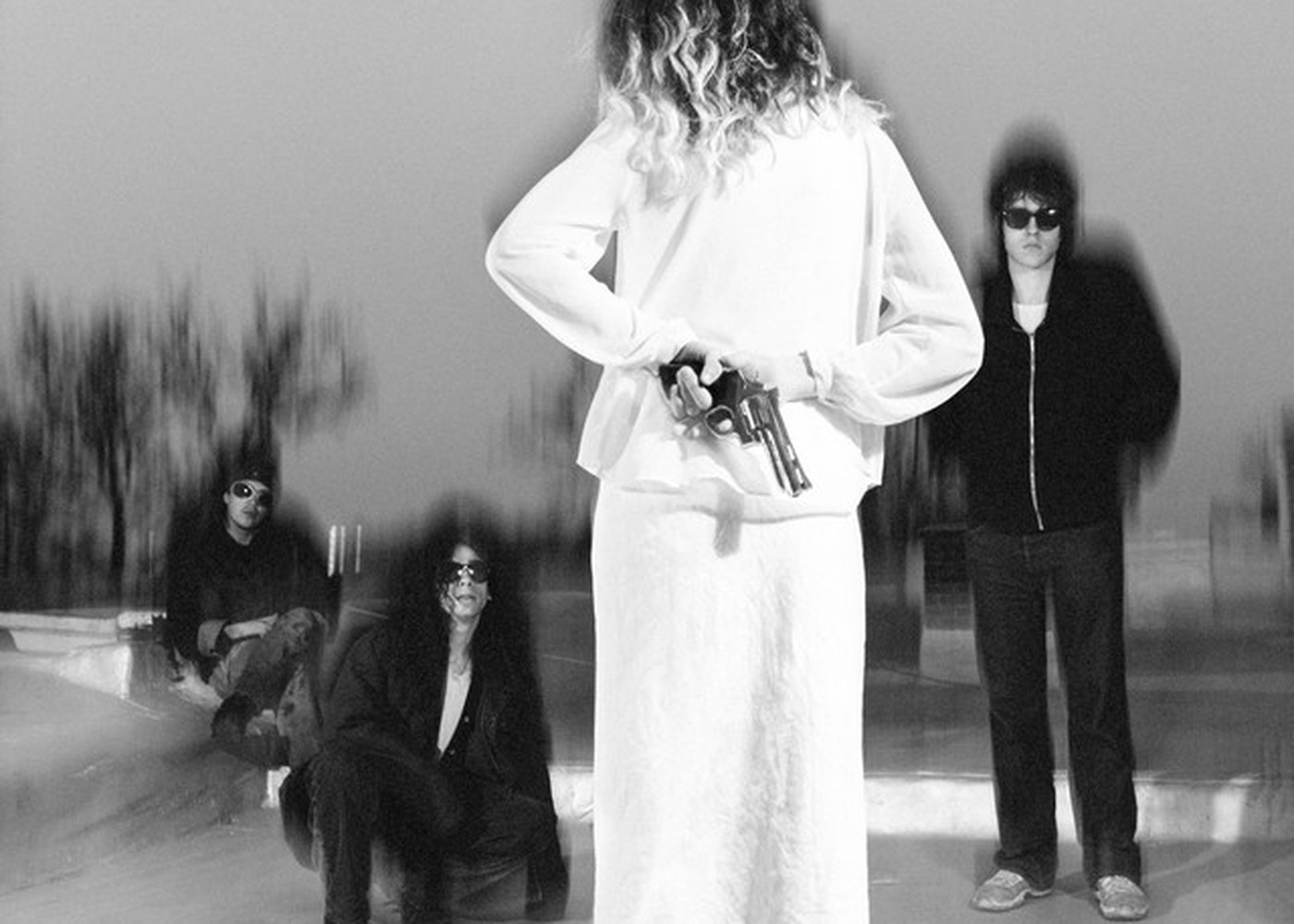
Geese's "Long Island City Here I Come" follows a narrator who opens as the only one who knows the way and closes on a midnight bus, admitting they have no idea where they're going. Long Island City is the song's afterlife. Hang a man from a yo-yo or a rope and he still gets there. The prophet's swagger covers a fear of being forgotten.
Introduction
The same song that threatens to kick your ass up and down the street also lays a man down dead behind a desk a million feet wide, and it delivers both with the same crooked grin. It is a brawl and a funeral at once. The narrator struts through a crowd of saints, kings and broken men, shouting a destination like a battle cry. The song keeps telling them the destination is death, the one place everybody reaches on schedule, and they keep refusing to hear it.
Verse 1: a prophet nobody asked for
The first move is pure arrogance. "Nobody knows where they're going," three times, and then the kicker: "except me." The narrator has appointed themselves the only person in the room with a map. Remember that claim. The song will take it back.
Next comes "poor Joan." The narrator scolds her for talking to "you-know-who" and demands the same access: if she can talk to him, she can talk to them. Then the song names her as Joan of Arc, the saint who heard God's voice and burned for it. She doesn't flinch at the narrator's jealousy. She fires back a warning.
"The Lord has a lot of friends, and in the end / He'll probably forget he's met you before"
The line I keep coming back to is this one, because it is so casual about something enormous. God appears as a busy man at a party, too popular to remember your name. Joan has the most famous divine connection in history and she still expects to be forgotten. The narrator called her "poor Joan." The pity points the wrong way. If even a saint gets lost in the Lord's contact list, a guy shouting on a street corner has no chance.
So they turn to Charles. "You were there the day the music died," the narrator says, borrowing rock's most famous eulogy phrase, "and I'll be there the day it dies again." They want to witness the end, to be present for something that counts. Charles answers with three short sentences that dismantle the whole project.
"A masterpiece belongs to the dead / There are microphones under your bed"
Take them one at a time. A masterpiece belongs to the dead because work only gets finished, judged and canonized after its maker stops breathing; you don't get to own your legacy while you're alive. The microphones under your bed put surveillance in the most private furniture you have, the place you sleep and dream and have sex. Then "footage that will prove us both wrong" seals it. Somewhere a tape exists that will outlast every argument the two of them could make. The record wins. The living lose.
The narrator's response is to pick a fight. "Like Joshua kick-kick-kicked the king out of Jericho / I'm about to kick your ass up and down this street." A biblical conquest gets shrunk to a sidewalk scuffle, and the stutter on "kick" gives away how much bluster is holding it up.
The chant that never arrives
Then "here I come," over and over, dozens of times. The phrase promises arrival and delivers repetition. Somewhere in the middle it breaks into wordless "ohh"s and then starts up again, like a person psyching themselves up in a mirror. If you're hearing this on headphones on the way home at 2am, you know the feeling: announcing yourself to a city that isn't listening.
Verse 2: everyone gets there eventually
The second verse is weirder. It drops the saints and gives us a gallery of men the narrator "knew." The first sits behind "a desk that was a million feet wide," power blown up to cartoon scale, and then "he laid down his hammer and he died." Two lines. The biggest desk in the world buys you nothing.
The second man is "big and fat, born without arms or legs / born to jump in the air and clap." It's a cruel joke and a tender one, and it goes by fast. A body built for one cheerful gesture it can't physically perform. He is the opposite of the desk man in every way, and he still gets the same ending.
"Hang me from a yo-yo or a rope / And I'll be hanging by my neck all the same"
The proof sits right here. A yo-yo is a toy and a rope is a gallows, and the man shrugs that it makes no difference. Then he adds: "So too shall I reach Long Island City, one of these days." However you die, silly or grim, you arrive in the same place. Long Island City is the afterlife, and the song gives it the plainest name it could find, a real neighborhood with a train stop instead of pearly gates.
He brags that "the Sunday crowds are all my concubines and my enemies," claiming the worshippers and the spectators alike. The narrator doesn't argue. They just note, "he too shall see Long Island City eventually." Every man in this verse, the powerful and the helpless, has the same appointment.
Maria talks back
Then someone finally pushes back. Maria cries out: "You can either leave / Or you can stop playing that cowbell with your gun." The image is ridiculous and exact. A gun, the most serious object available, gets used as a drumstick on a novelty instrument. Maria sees the narrator's whole act for what it is: menace turned into noise.
The narrator leaves. "Watch out, Long Island City, here I come," still in full swagger, and then the comparisons start sliding.
"Like Charlemagne in Vietnam / Until I get home, I am not anyone"
Charlemagne was an emperor who built an empire, and the song drops him into a war twelve centuries out of his time, a conqueror with no army and no idea what continent he's on. That's the narrator now. The next simile shrinks him further: "Like Charlemagne on the midnight bus," the least heroic ride available. Then the confession arrives with no fanfare: "I have no idea where I'm going." The person who opened by claiming they alone knew the way now admits they're lost, and never notices the reversal.
"Until I get home, I am not anyone" is the line that gives the game away. Joan warned that the Lord forgets you. The narrator has now accepted being nobody, at least until arrival. A fair listener could read Long Island City as literally home, a kid kicked out of a party heading back to Queens on the last bus, and the lyric does allow that. I think the yo-yo and the rope make the bigger reading unavoidable, though: home and the end are the same stop.
Conclusion
The outro gives up on words. No more "here I come," just "ohh" after "ohh," worn out and strangely gentle. The narrator spent the whole song trying to be the one God remembers, the witness at the end of music, the conqueror of the street. The song lets them become one of the Lord's forgettable friends instead, riding toward the place everyone ends up. And the music doesn't sound afraid. Being nobody on the midnight bus turns out to be the first honest thing the narrator has done all night.
Frequently Asked Questions
What is "Long Island City Here I Come" by Geese about?
The song follows a boastful narrator who claims to be the only one who knows where they're going, then ends up lost on a midnight bus. Along the way, saints and dying men keep pointing to Long Island City as the place everyone reaches eventually, which makes it work as a stand-in for death or the afterlife.
What does "A masterpiece belongs to the dead / There are microphones under your bed" mean?
Charles is telling the narrator that great work only gets its final meaning after the maker dies, so nobody living gets to own their legacy. The microphones under the bed suggest that even your most private life is being recorded, and the following line about footage proving them wrong says the record will outlast anything they argue.
What does "Like Charlemagne in Vietnam / on the midnight bus" mean?
Charlemagne was a medieval emperor, so placing him in Vietnam or on a midnight bus turns a great conqueror into someone hopelessly out of place. The narrator uses these images right after being thrown out by Maria, and the next line admits "I have no idea where I'm going," which shows their grand self-image collapsing.
Lyric analysis powered by Scalpel.


Comments
Loading comments…