

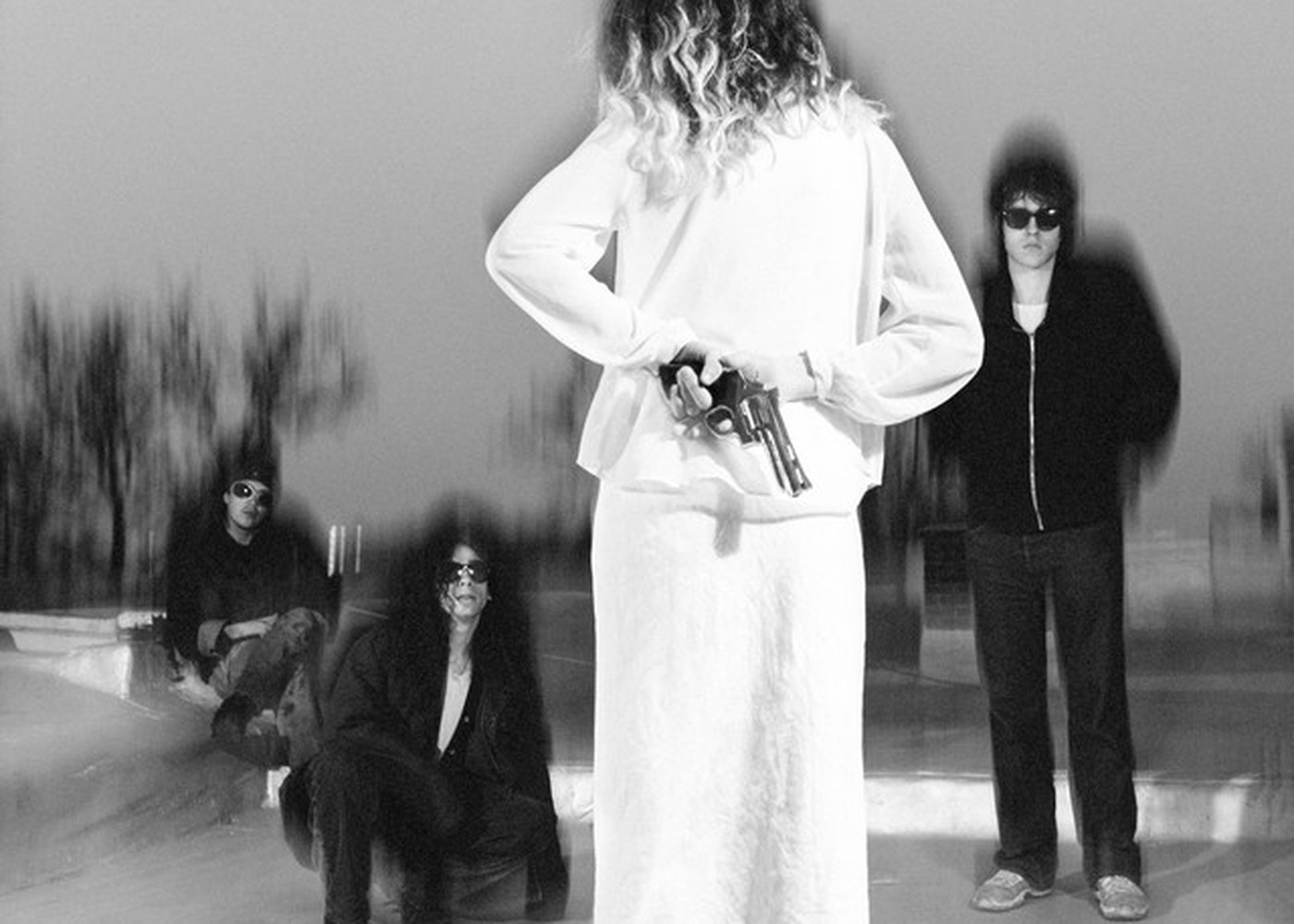
Someone is kneeling in the middle of a turnpike, traffic bearing down, with an angel jammed down their throat. A woman standing nearby informs them they have no idea what it means to bow. That is the dark joke at the center of Geese's "Bow Down," and it gets darker every time the chorus comes around. The song is about devotion that hollows a person out: the narrator has worshipped a dead woman's bones until nothing is left but a surface for other things to move across, and when the song finally swaps those bones for "the power of love," the kneel stays exactly the same.
Sailor to boat: handing over the wheel
"I was a sailor, and now I'm a boat"
Every pair in the first verse runs in the same direction. The sailor steers, and the boat gets steered. The car drives, and the road gets driven over. The narrator has slid from subject to object, from the one doing the moving to the thing other people move across.
On first listen it plays as a riddle shouted while falling, and there's a grin in it. You could even hear the change as an upgrade, since a boat is bigger than a sailor and the road outlasts every car. But a road can't choose where anyone goes. The narrator gained size and lost will.
The verse never says who took the wheel. The answer shows up a few lines later, and it's dead.
Prayer in the fast lane
The pre-chorus puts this road-person on their knees, and on a turnpike specifically. A turnpike is a toll road, built for paying and passing through. Nobody stops on one. The narrator stopped anyway.
"And I was kneeling on the turnpike / With an angel down my throat"
It's a slapstick picture of prayer, someone genuflecting in traffic. The angel sits lodged in the throat, swallowed or forced, closer to choking than to grace. Whatever holy thing got inside this narrator is blocking the airway.
She gets the best lines, he gets the knees
Then she speaks, and she owns the chorus.
"She said 'You don't know what it's like / To bow down, down, down to Maria's dead bones'"
The irony is brutal. She tells the narrator they don't know what bowing is like, and the narrator is the one on the asphalt. Either she can't see what's in front of her, or she means something deeper: you can kneel all day and still not understand what you're kneeling to.
Verse two explains the whole before-and-after machine from the opening.
"I was in love, and now I'm in hell / With Maria's bones talking to myself"
Love was the sailor. Hell is the boat. The second line is gloriously tangled, too. Either the bones are doing the talking, or the narrator is muttering to themself with the bones for company. One version is a haunting. The other is a person alone at a reliquary, and honestly that's the bleaker picture. Bones carry both meanings at once: a saint's relic you'd kneel before in a cathedral, and a plain skeleton in the dirt.
Then she drops her two best lines back to back. "He with least money has the most to sell" is a grim economics lesson. When you own nothing, everything you are goes on the market, including your knees, which ties straight back to that toll road. The broke pay with themselves.
"I've met angels so deep undercover / That they'd sit on Solomon's throne"
This is the line I keep coming back to. Solomon's throne is the seat of wisdom itself, and she's saying the holy can hide so well it passes for the ruler in charge. Flip it and it turns nastier: whoever sits on the throne might be an angel or might be an impostor, and you can't tell from your knees. For a narrator with an angel stuck in their throat, that's a warning. The thing you swallowed as grace might be running the place.
The second chorus also loses a word. "Dead" falls out, and Maria's bones are just bones now, as if the death matters less the longer you kneel to it. So who is Maria: a lover, a saint, the Virgin herself, and does it even matter to someone already on the ground?
The outro changes the altar, not the posture
After a long stretch of nothing but "down," the outro pulls its trick.
"To bow down, down, down, down... / to the power of love, bow down"
Fourteen downs, and then the target swaps. Maria's bones become "the power of love," and the bow stays put. The song has been drifting toward this all along: first a dead woman's bones, then just bones, then something abstract enough to worship forever.
The quote marks vanish here as well. Every earlier "you don't know what it's like" belonged to her. In the outro nobody claims it, so it could be the narrator saying it to us, to themself, or to whoever is still listening.
A fan could hear this ending as release, the narrator finally bowing to something alive instead of a grave, and the warmth of the phrase backs that reading up. I don't buy it. The narrator called love hell one verse ago, and fourteen repetitions of "down" wear devotion into exhaustion. Love doesn't rescue anyone from the bones; it inherits their altar.
Conclusion
Go back to that turnpike. The narrator kneels in a place built for passing through, swallowing something holy, being told they don't understand the very thing they're doing. "Bow Down" leaves them right there. The real horror of the song is how little the object of worship matters once the knees have learned the motion: a dead woman, a hidden angel, the power of love, all of it gets the same posture, and the person bowing keeps turning into road. By that last "bow down," the chorus has you singing along, which means you're down there too.
Frequently Asked Questions
What is "Bow Down" by Geese about?
"Bow Down" is about devotion that empties a person out. The narrator kneels to "Maria's bones" until they've gone from the one steering their life to the thing being steered, and in the final line the object of worship changes to "the power of love" while the bowing stays identical, putting love and a corpse on the same altar.
What does "I was a sailor, and now I'm a boat" mean in "Bow Down"?
The line swaps the one in control for the thing being controlled, just like the companion line about a car becoming the road. The narrator has lost agency and become a surface others move across, and the later line "I was in love, and now I'm in hell" shows that love is what caused the change.
Who is Maria in Geese's "Bow Down"?
The song never says. Maria could be a lost lover, a saint whose bones are kept as a relic, or the Virgin Mary, and the lyrics keep all three possibilities open. The word "dead" drops out of the second chorus, so her bones become an object of worship detached from any specific death.
Lyric analysis powered by Scalpel.


Comments
Loading comments…