

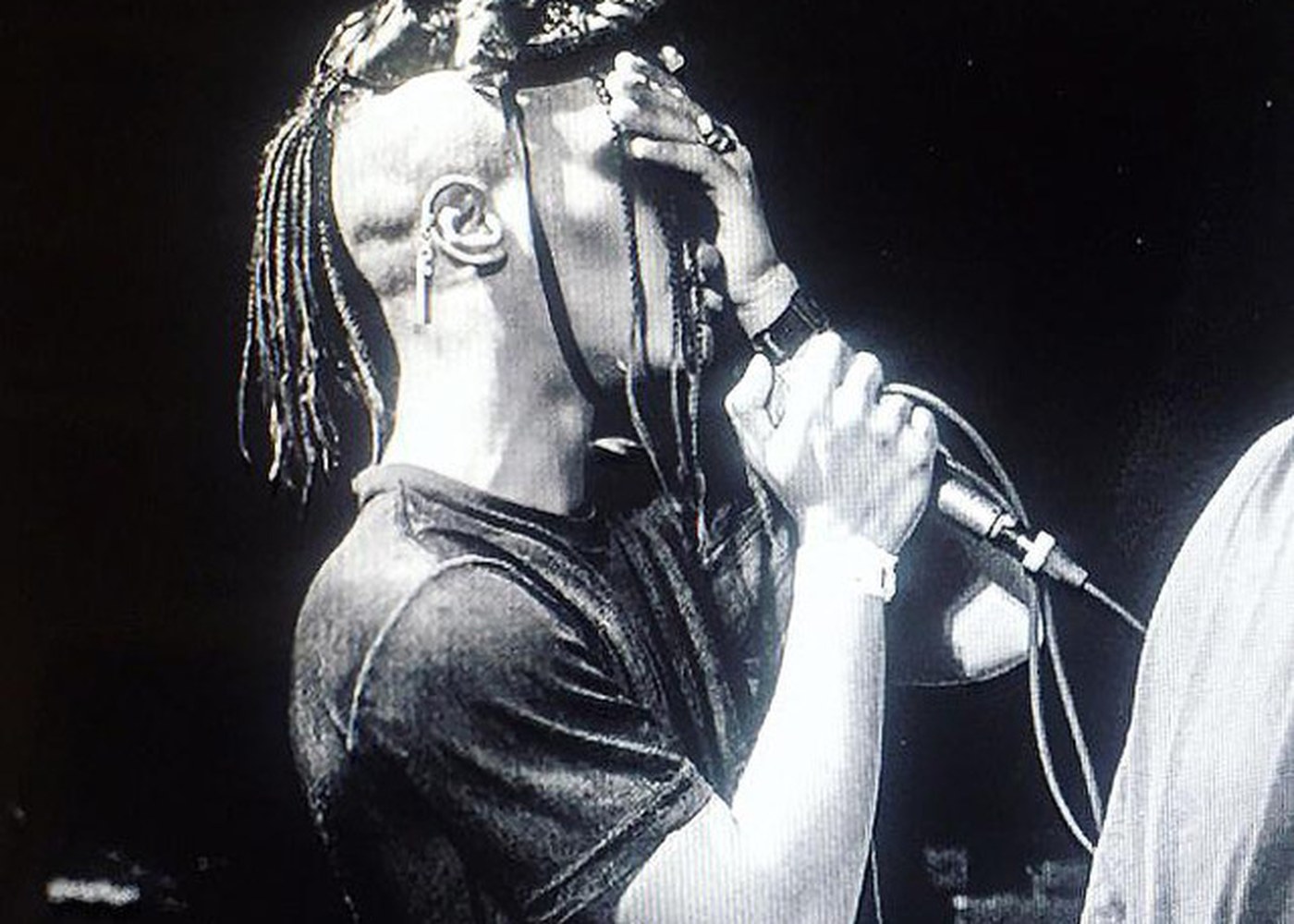
Lie back. Look up at the fan turning over your bed. Your body is heavy, your head is somewhere above it, and you want up without wanting out. "Sky Burial" keeps you pinned in that position for its whole length. It is a funeral the narrator holds for themselves while still breathing, and its strangest wish is to become the bird that carries the dead into the sky, leaving the corpse role to someone else.
Magnetic north: a receiver with its mouth shut
The song opens at the top of the world. Cold, remote, alone.
"Magnetic north, all alone with antenna / Inner monologue silent, omerta"
An antenna only receives. Omertà is a vow of silence, the kind you swear so nobody talks. Here the vow is taken by the narrator's own head, so even the voice inside has agreed to say nothing, and what's left is pure listening, a body tuned to a signal it hasn't caught yet. Then the request: "Send them up so high, sky burial." Who "them" is stays unnamed. The dead, maybe. Or the pieces of the narrator they're ready to give away.
The dove in the ceiling fan
Then comes the image everyone asks about.
"Feathers of a dove still stuck in the ceiling fan"
In a sky burial, birds lift a body off the earth. This bird got no lift. It flew indoors and met a machine that spins air around a closed room. A dove, the bird of peace, chopped by an appliance and left there. The word "still" is the cruel part. It happened a while ago, and nobody climbed up to clean the blades.
That's the line I keep coming back to, because it shows the failure the whole song is trying to avoid. Wings are useless under a ceiling. Spin without escape just shreds you. The narrator is lying in the same room as that fan, wanting the sky, staring at what happens to things that try to fly from inside.
The next lines turn the room into a body. "Invisible, never caught on video" means whatever is happening leaves no proof. Then "Sickness, vertigo, highness imperial," which stacks nausea, dizziness, and a royal title that also just means very, very high. (Honestly it's a little funny. Your Highness, you look green.) Being lifted and being sick sit in the same line, and the song doesn't separate them yet.
Then the compass flips. "Magnetic south, so cold, under setting sun," followed by "Coriolis, molten hot interior." The narrator has stood at both ends of the needle now, so the body points everywhere and nowhere, frozen on the surface, boiling at the core, while the Coriolis spin quietly winds up the storm that will come later. Then the chant: "High, go high, go higher, go!" It's sung like a rule. An order given to no one in particular.
"There you are": alone becomes us
Three words, and the whole song changes temperature.
"There you are / Always knew, it was us all along"
Before this, everything is "I." Alone, cold, sick, mapping poles. After it, there is only "we" and "us." And "all alone" from the first line comes back rhymed as "all along," as if the company was there from the start and the narrator just couldn't see it through the vertigo.
Who is "you"? A lover, a god, a lost self. A grieving fan could hear it as the dead, found at last in the sky where "them" was sent, and that reading holds up. The song refuses to say, and that refusal fits a narrator who just spent a verse under a vow of silence.
The final prayer: free, whole, and hollow
Now the motion stops being dizziness and becomes flight. "Farther on, into nothing, we have gone / So far, there's no fear in us." Then, sharply: "So far from obedient." This from a voice that has done nothing but pray and repeat commands. The disobedience is aimed at gravity, at the room, at the ceiling. The orders it follows all point up.
"Taken by a cyclone" pays off the Coriolis spin from earlier. The same twisting force that pinned the dove in the fan now carries the narrator off. Spin was a trap indoors. Outdoors it's a ride.
"Birdsong in our hollowing bones"
Birds have hollow bones. That's how they fly. The narrator's bones are hollowing, and there's song inside them, which means the body is becoming the bird instead of feeding one. The title flips on itself. In this sky burial nobody gets eaten. The dead person grows wings.
"Don't want to live forever / Want to be free and become whole"
The prayer turns down immortality flat. Forever would mean staying a body, staying in the room. What the narrator wants instead is to be free and whole, and the song treats those as the same thing reached by letting go. Wholeness comes from dissolving into the sky, from losing the edges. "Be this my final prayer" has the formal weight of a rite. Then the chant returns, and the song never actually arrives anywhere. It just keeps saying higher.
Conclusion
Back to the ceiling. The dove is still up there, and the song never pretends otherwise. What it offers is a way of leaving that doesn't require the blades, a burial where you rise with the birds and become one. I hear it as a song for people who want to stop holding on without wanting to stop living, and the hollow bones are its answer: you don't get carried away, you learn to carry yourself.
Frequently Asked Questions
What is "Sky Burial" by Ecco2k about?
"Sky Burial" follows a narrator who starts out alone, silent, and dizzy, then finds a "you" and rises into flight. The song uses the ritual of sky burial, where birds carry the dead upward, but flips it so the narrator becomes the bird. It ends with a prayer to be free and whole rather than to live forever.
What does "feathers of a dove still stuck in the ceiling fan" mean in "Sky Burial"?
The line shows a dove that flew indoors and got caught in a spinning fan, its feathers left in the blades. It contrasts with the sky burial, where birds lift bodies into the open air. The image captures flight gone wrong when it's trapped under a ceiling.
What does "Don't want to live forever, want to be free and become whole" mean?
The narrator rejects immortality and asks instead for freedom and wholeness. In the song, becoming whole means letting go of the heavy, earthbound body and dissolving into the sky. Paired with the line about birdsong in hollowing bones, it frames release as a kind of becoming rather than an ending.
Lyric analysis powered by Scalpel.


Comments
Loading comments…