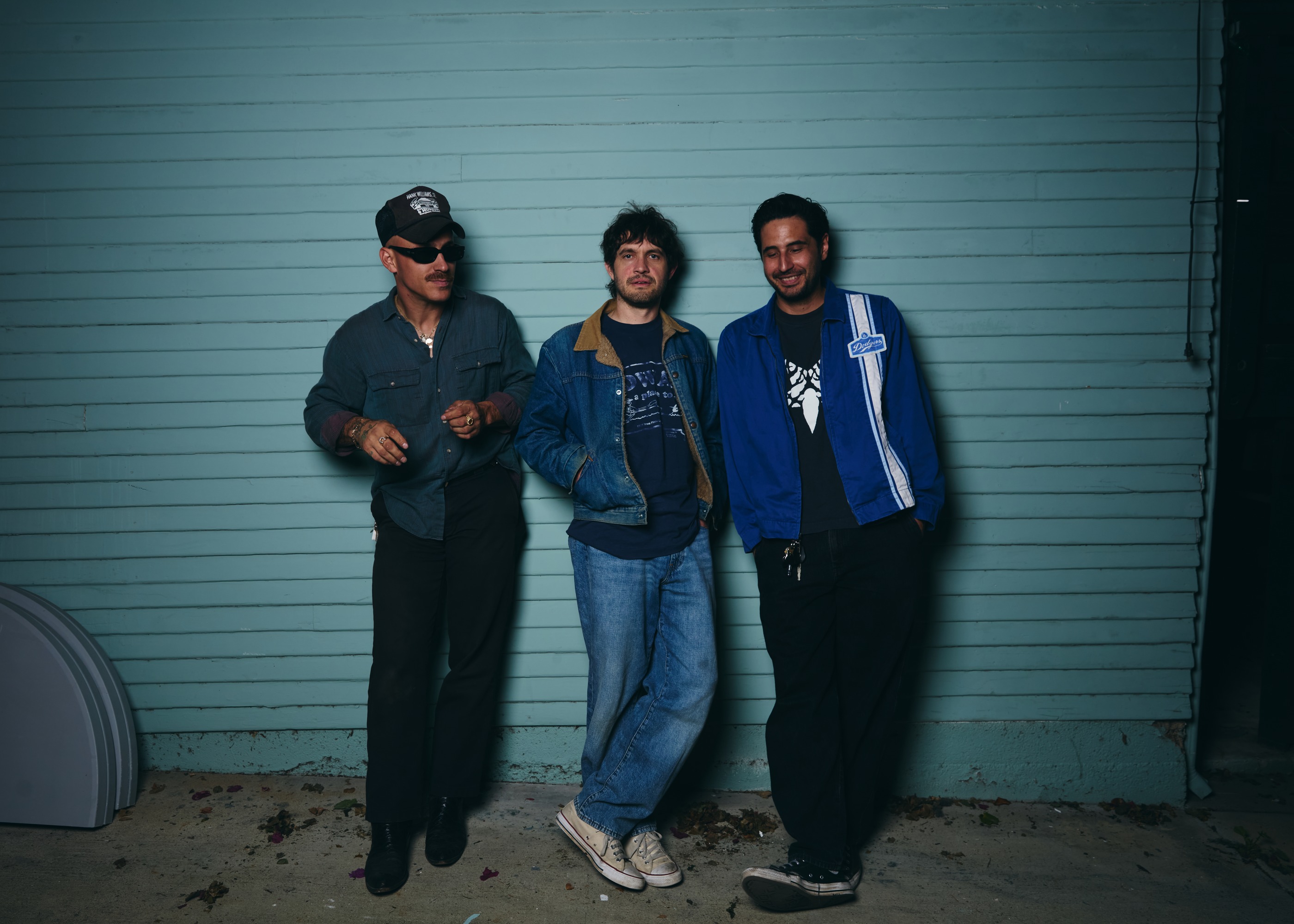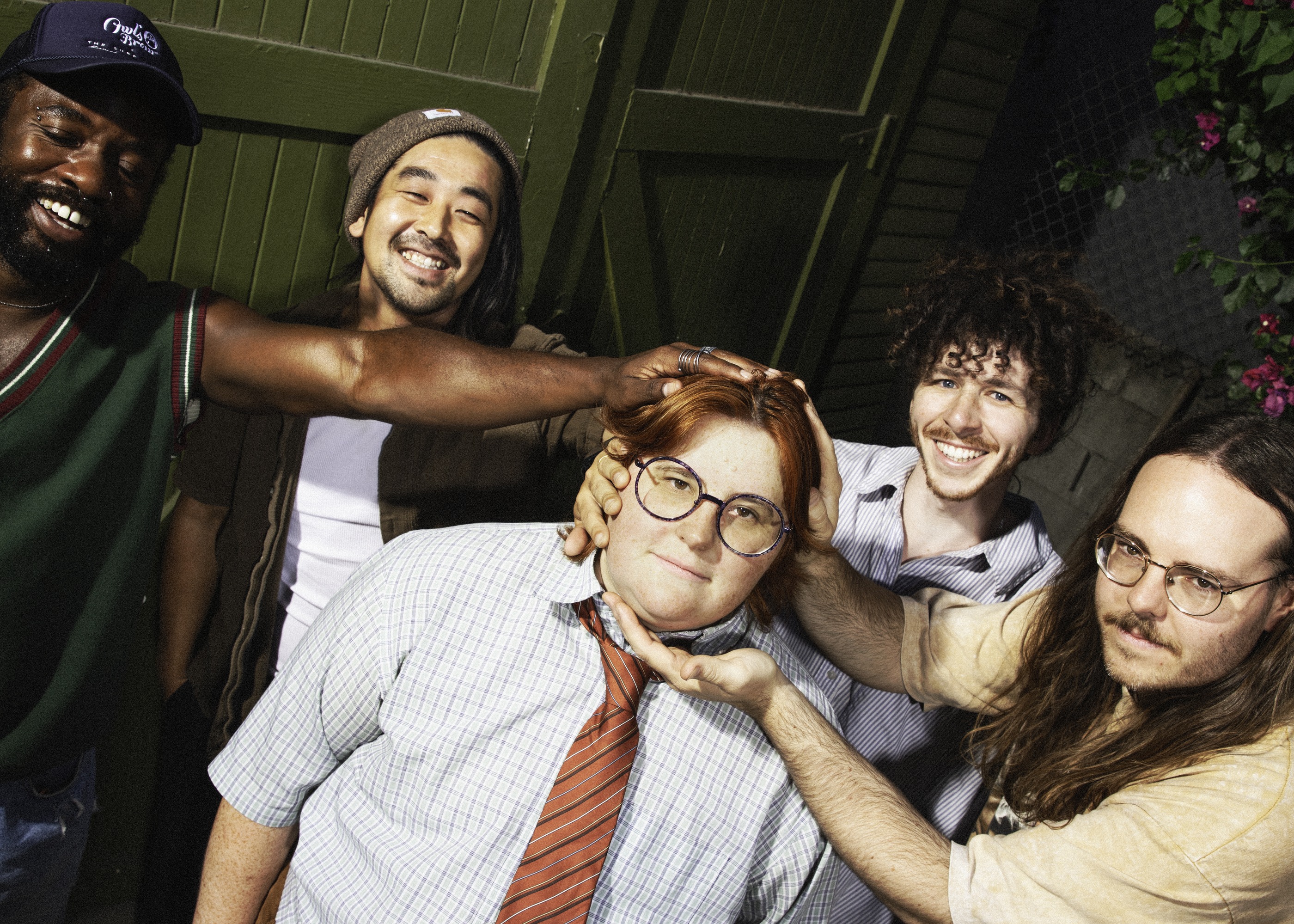

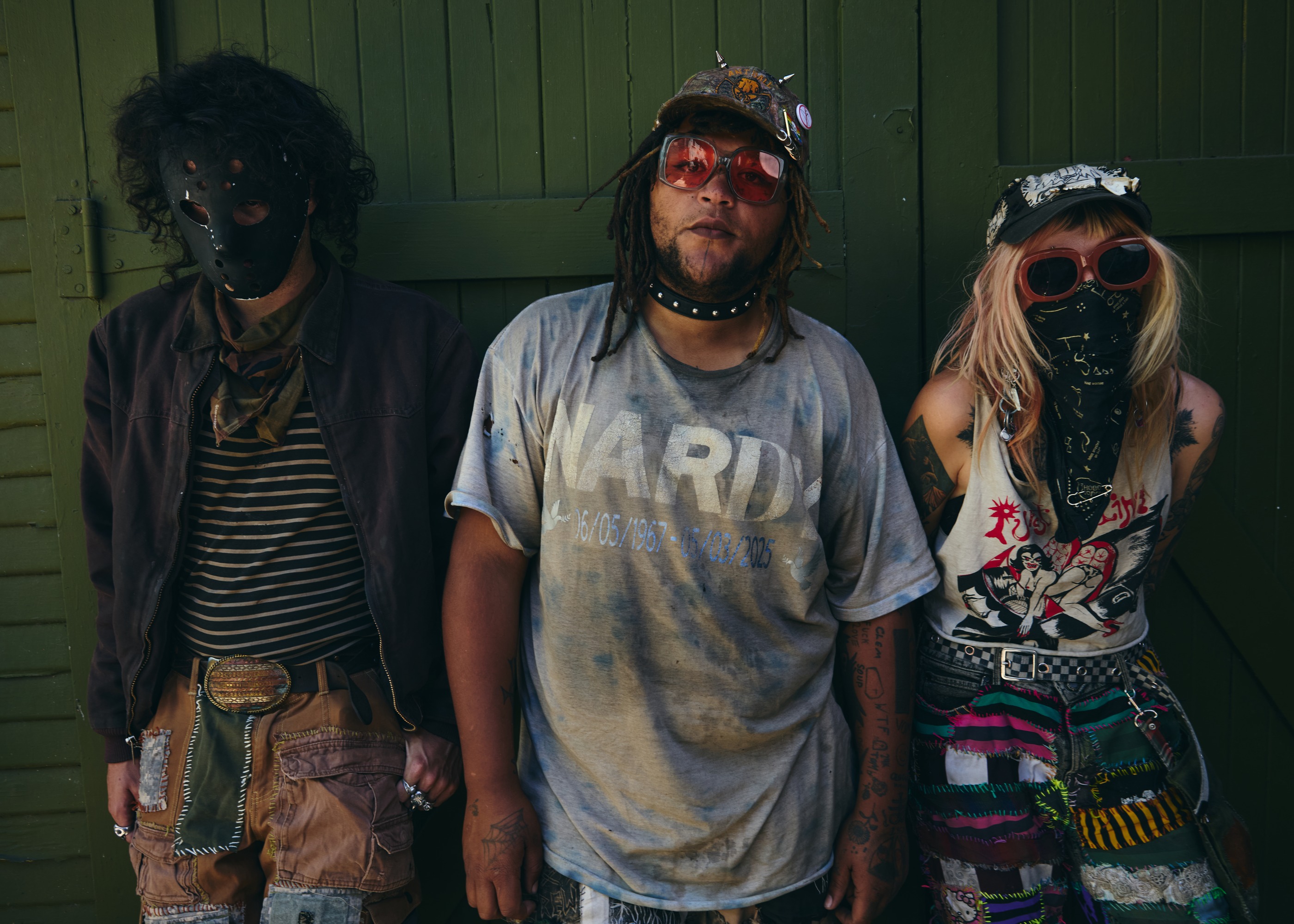
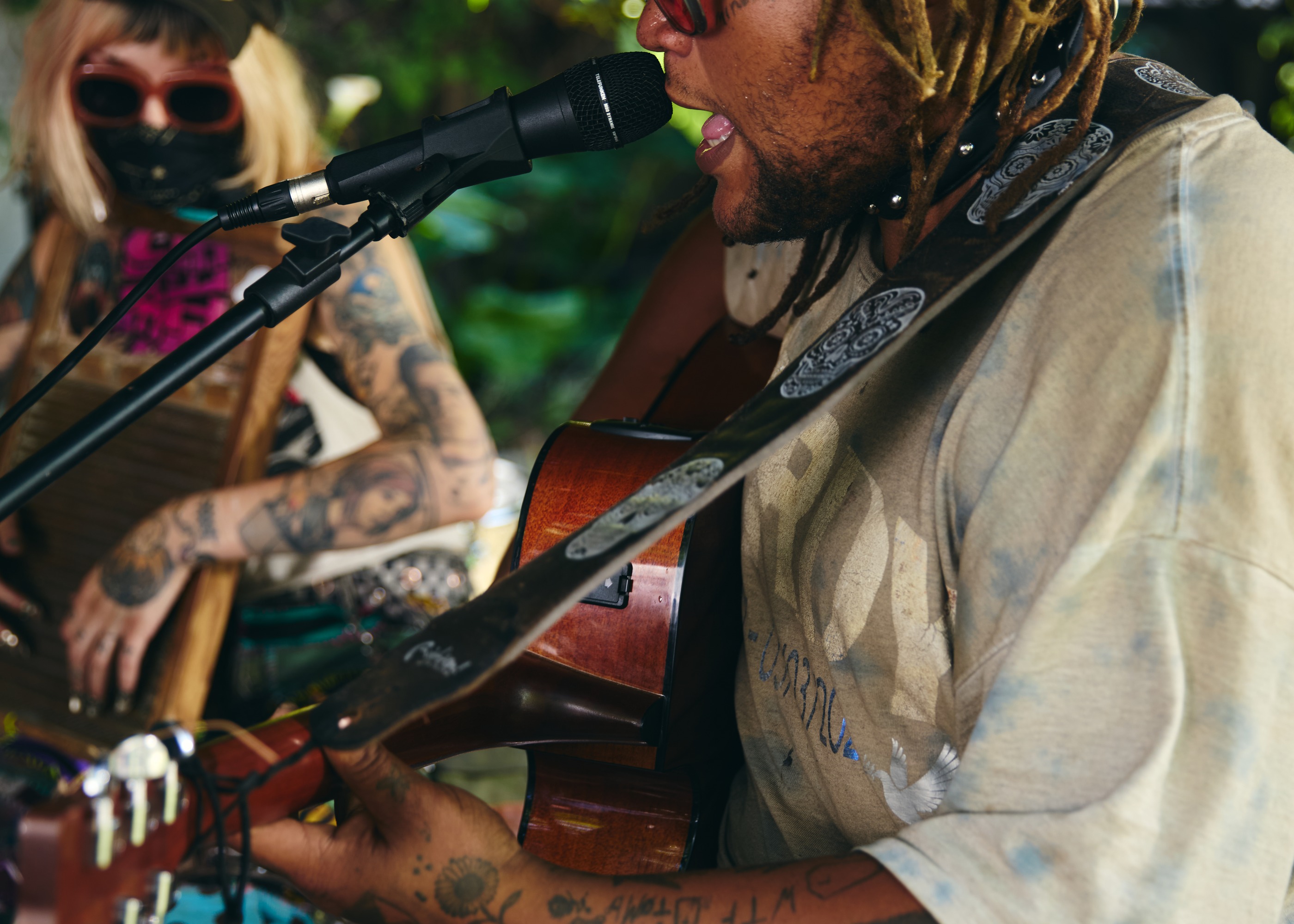
Crisis Crew rolled into Los Angeles sleeping in a van — one member and her partner pitching a tent in what they generously called a "beautiful highway ditch" in the LA hills — and sat down with Medicine Box at Medium Sized Backyard for one of the most disarmingly honest conversations the series has seen. Equal parts road diary and music manifesto, the interview careens from coining genre terms like "blue gaze" and "shoe grass" to a surprisingly moving meditation on why busking still matters even as the world goes cashless.
On How Crisis Crew Came Together
Medicine Box: I need the Crisis Crew lore. Talk to me. How did this come about? I know bits and pieces, but I'd love to hear from you guys how this happened.
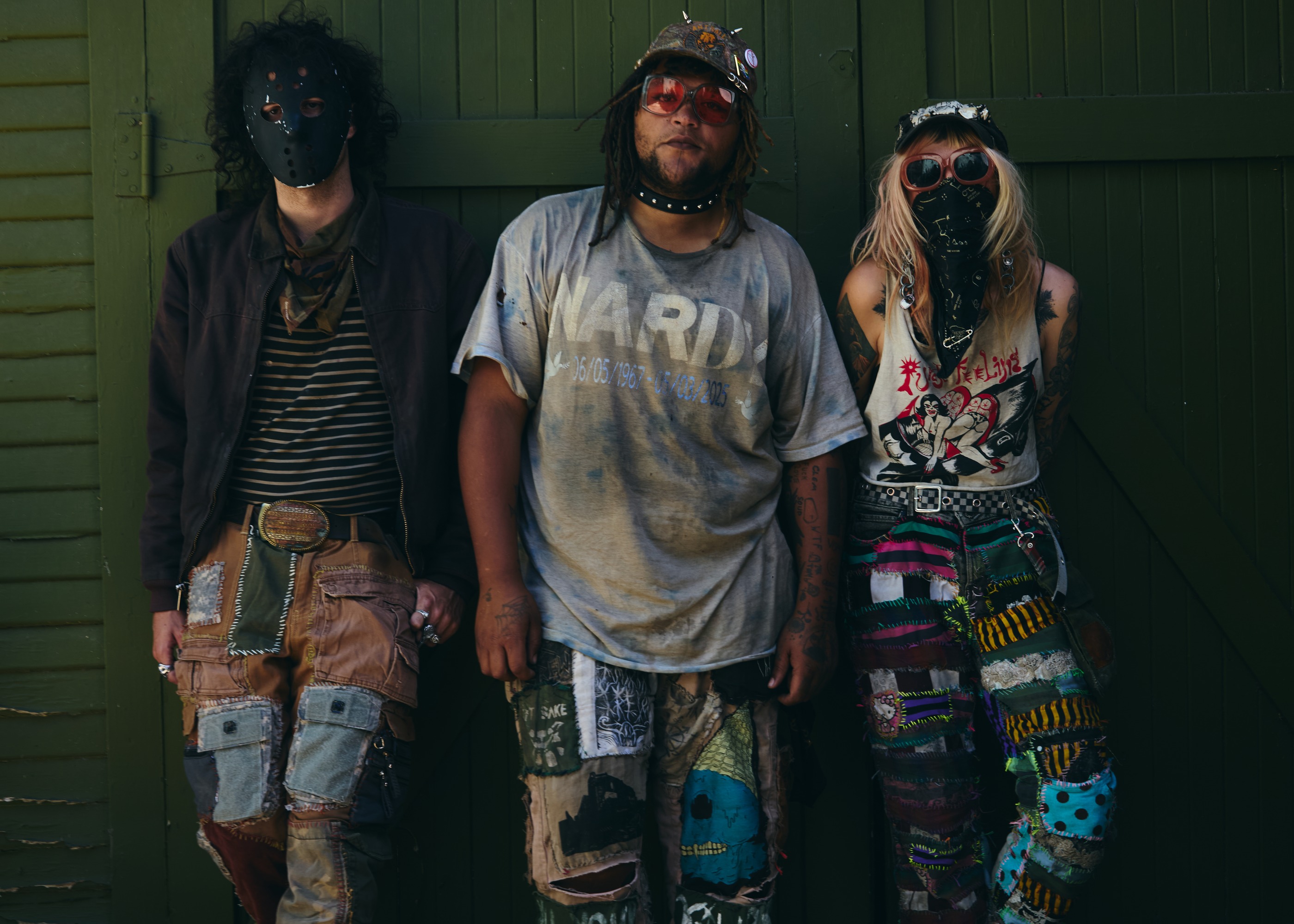
Crisis Crew: We'd all been traveling separately for quite some time and then met roughly three years ago in New Orleans, just playing on the street. We ended up staying in this house together that was just a mess — and out of escaping that house together we kind of formed this little trio bond. It probably wasn't until Michigan, where we broke down in a school bus for a couple of weeks, that the Crisis Crew was really born. There was nothing to do but play music. We were living in the back lot of a mechanic shop and happened to be there right on July 4th — this tiny little backwoods Michigan town. Shout out Ludington. More American flags than I've ever seen in my entire life on every surface, and we're just walking around looking like this.
Medicine Box: What was the turning point of like, "Oh, this could actually be a thing?"
Crisis Crew: We had to walk like 30 minutes to the nearest grocery store, so we were just sitting on the school bus with nothing to do but play homebrew D&D and write music together — and that was pretty much it. But I think back to one of those moments in New Orleans too. Before we left, we went and busked together. It was one of the first times we'd ever played together, just trying to make a couple bucks, and it was immediately clicky. In that moment I was like, "I want to play with these guys for a minute." I didn't think three years later we'd still be here — that rarely happens — but here we are.
On New Orleans and Its Influence
Medicine Box: You said you met in New Orleans. New Orleans has such a rich music lineage. Do you feel like you pull that into your music? How has living there inspired the sound?
Crisis Crew: Definitely, greatly. Especially on the project we're about to release, there are all these little New Orleans Easter eggs and themes — if you know them, you can find them. And since we kind of originated there, we really want to platform that area and the smaller, cooler music scene that exists there. Independent people making really raw, vulnerable music. I think our sound is indicative of what you can hear just walking the streets of New Orleans. The jazz aspect of what we do is rooted in that. You wake up every morning and you hear the same cover band playing "Walk On By" or something, and you just hear that every day all day long. It's kind of hard not to let that seep into what you do.
On the Genre They Invented
Medicine Box: If someone came up to you and asked, "What is Crisis Crew's sound?" — what would you say?
Crisis Crew: We've been trying to coin the term "shoe grass." Or "blue gaze" is another one we've been playing with. It's definitely got those two influences the most. I come from kind of a bluegrassy, blues background on guitar, and I listen to a lot of indie shoegaze bands — like Great Death and those kinds of guys. They meld in our sound into this really spacey, environmentally inspired slow rock music mixed with the fast pickingness of bluegrass and southern music influence. That's probably the best way to describe it.
On Van Life and Living Together
Medicine Box: You guys live in a van and travel together — I need more context there. How did that come about, and how is it being not only collaborators but also roommates?
Crisis Crew: Things can be tense sometimes. We love each other — we love each other so much. But I think the real truth is that underneath it all we actually like each other. The fact that we can spend so much time every single day — we wake up and are immediately working or immediately traveling thousands of miles — I think we've found a good balance between how much space we need and what the future looks like. Hopefully we're not all four living in a minivan in the very near future.
Medicine Box: Are you going to look back on this time fondly, or are you like, "We are ready to move out of the damn van?"
Crisis Crew: I think we're going to be living in two vans. I do think fondly of the first trip we took together out of New Orleans — we had a bigger van. We went pretty much nowhere over the course of two months. It was nice. We're sleeping in the van right now. Jackie and her partner are in a tent off the side of the van — beautiful highway ditch up in the LA hills. There are some great pull-offs. You could live there for three days if you wanted. The day in the life definitely involves hummus at some point, and coffee. And the days end early when you go to sleep with the sun, you know. We try to be tucked in bed ready for 8 p.m. and fall asleep like grandmas. You wouldn't think it to look at us, but we're all sober.
On the Songwriting Process
Medicine Box: When it comes to the music-making process, how do you each add to it? Who is more on the songwriting and production side?
Crisis Crew: Almost every song is almost entirely hers, and then we'll throw in some lyrics on a couple of them. From there our parts we pretty much independently work out and layer over the top to see what sounds good once the core frame of the song's been written. To compare it to building a house — I kind of hang the framing and the foundation, and then I'll bring it to these guys and ask, "Does this work? Is this our sound?" And from there the songs evolve so much. I've kind of been in the habit of writing something and having it sit, but I know for sure that when I bring a song to these guys it ends up metastasizing beautifully into something else. That's kind of where we end up in that little sweet zone where we try to record them — because they continue to evolve past that too. We work on them together until we feel like, okay, this is maybe the spot where the song is done. And then we'll get in the studio. I do most of the production stuff.
On the Upcoming Album
Medicine Box: Can we talk about the new music? How does it feel with a new album on the horizon?
Crisis Crew: I'm pretty sure I can speak for these guys when I say we're all excited about this project. The songs making it onto this next album were originally intended for our first release, and then just didn't make it onto that album. So we kind of made a different record to begin with that didn't have these songs on it. Now, to be bringing them to fruition and actually having all these songs we already wanted to release ready to go — it's nice. It makes us really pumped about what we're putting out. And personally, I've been playing pretty much my whole life — acoustic folk, fiddle — so I'm excited to go electric with it. Do some more spacey type of sound.
On Busking Culture and Taking Up Space
Medicine Box: Busking culture is still very much alive, and I want to talk about what it's done for you guys and any tips for aspiring artists who might want to do things like that.
Crisis Crew: You can make a lot of money at Walmart before they kick you out. It's a mixed bag. As we ease into the digital world more and more every day, the money is definitely drying up as far as traditional busking goes — people don't have cash. If you do it, I think it's a homage to your dedication. You'll hear a lot of people say busking made me the musician I am. You spend the entire day either getting to the spot or playing. You maybe take a lunch break and then you have to play for six more hours. That breeds a work ethic that's really healthy. But it's not a sustainable way to make money for your art the way it was 10 or 15 years ago. When I first started busking I was definitely making enough money to live in a house and do okay just from playing guitar in the streets. The global shift to digital currency is really to blame for that. But there's only really one tip and it's just to do it. Find a place — whether it's a Walmart or a Trader Joe's or a Goodwill. If you can sit there and play, you should.
Crisis Crew: The culture has definitely gotten more hostile — to people being outside in any capacity, for any reason, whether that's playing music or sitting on a bench. There's no room for that anymore. People are upset if you feel like you're allowed to take up space. And that's one of the reasons busking is so important — because it teaches you that you are allowed to take up space. I am an artist and I'm allowed to make my art.
Medicine Box: I agree with that absolutely. Well, I can confidently speak on everyone's behalf here — you've earned 20 new fans in the last hour. Crisis Crew, thank you so much for coming. Last question: where are you off to next?
Crisis Crew: Oakland. Headed up to the Bay to see some friends and play some shows.
Medicine Box: Amazing. Thank you guys again.