

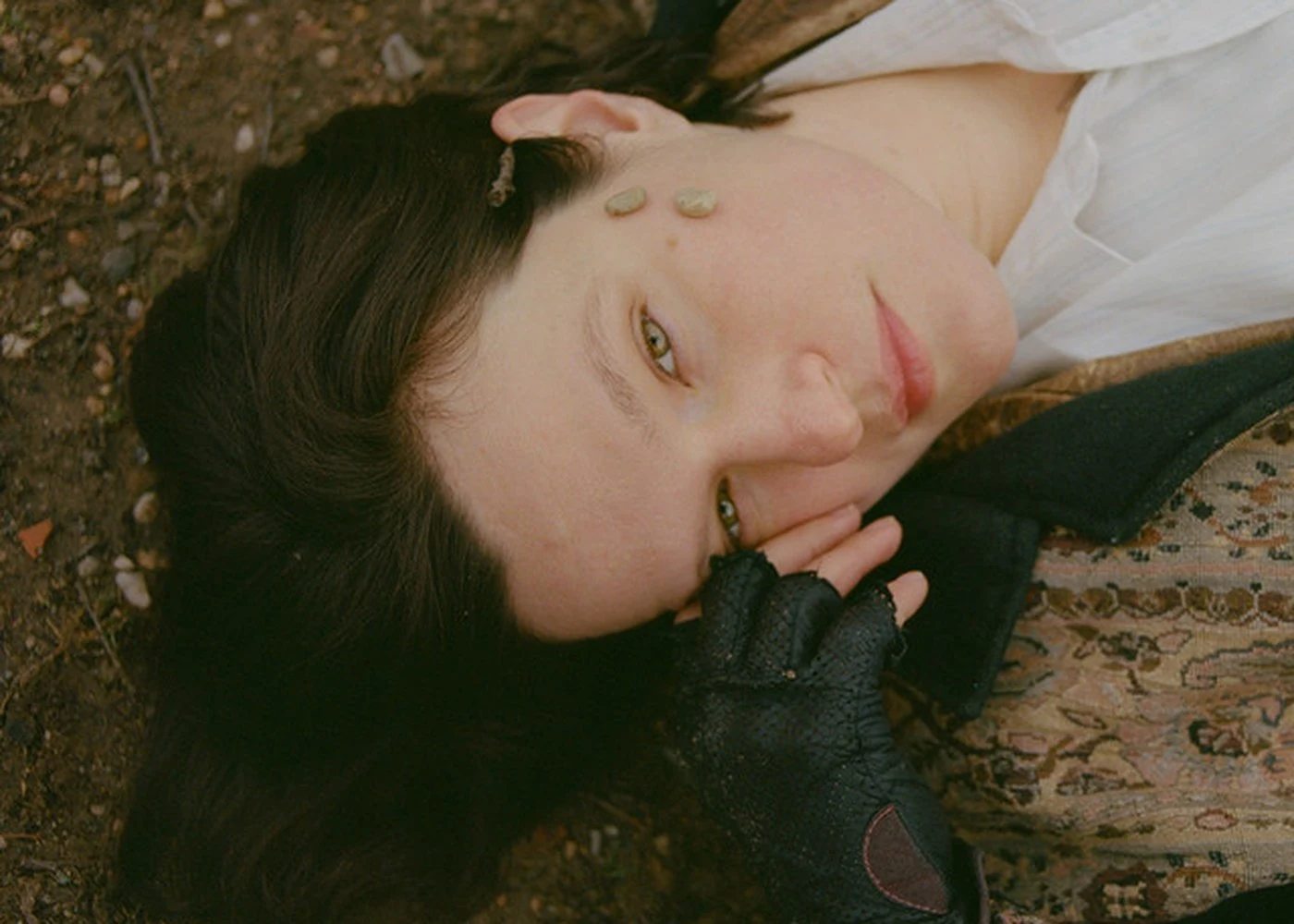
A pair of jeans hangs from a clothes pin, and the narrator's skin is still wet. Somebody has mango juice running down their chin, and a shirt is sliding off a shoulder in the heat. "anything" spends most of its length inside moments like these, hot and close and happening right now. My read is that the song is about a relationship already coming apart, and the chorus that keeps begging to skip the talking is the sound of someone who knows that words are where it broke.
A summer with a gun in it
The very first image is a threat. The sun gets stared down "the barrel" and shines "with the sheen of a shotgun," so even the warmest light in the song comes pointed at somebody. Then it relaxes into friends and favors: Carol "has a little, if we need some," Joa "has a ride." What Carol has is never named. It doesn't need to be. The point is that everything is on offer and nobody has to ask twice.
Look at how the verse is built. No full sentences, barely any verbs with subjects attached. "Mango in your mouth, juice drippin'." "Shoulder of your shirt sleeve slippin'." These are snapshots, held up one after another, and every one of them sits in the present tense. The narrator is living right up against the lover's body, close enough to watch juice move down a face.
Christmas Eve: where the words go wrong
Then the season flips. Same rhyming fragments, same breathless pace, but now it's Christmas Eve "with your mother and sis," and the mother "insists" on a fight the narrator doesn't want. A dog's "white teeth slice right through my fist." A drive to the ER. The verse moves so fast that the bite gets one line and the hospital gets half of one.
"You put me on risk" is the strangest phrase here, and the song refuses to explain it. Maybe it's hospital paperwork. Maybe it's an accusation. Either way, it's the first time the lover does something to the narrator rather than with them, and it slips by in the middle of a rhyme like the narrator can't afford to stop on it.
Then come the fights that actually matter. "Grocery store list, now you get pissed." "Unchecked calls and messages." Notice what these two have in common. They're both about language: a written list that starts an argument, messages that go unread. The relationship starts failing at the level of words, and it fails over nothing.
"I don't wanna be the owner of your fantasy / I just wanna be a part of your family"
That couplet comes right after a holiday at the lover's family's house that ended in blood and a fight. The narrator still wants in. It's a sad, stubborn wish, and it sets up the chorus perfectly.
Because then: "I don't wanna talk about anything." Repeated. Then "anyone," repeated. After a verse full of mothers who insist, grocery lists, and ignored calls, the refusal to talk makes complete sense. Talking is where this goes bad. What the narrator wants instead is all body and no speech: to kiss the lover's eyes, to "sleep in your car while you're driving," to "lay in your lap when I'm crying." Crying shows up in the chorus as a given. Something is already hurting.
The sound of you blinking
The second verse builds a shelter. "Circle of pine and red oak / Circle of moss and fire smoke." The narrator draws a ring around the two of them, trees and smoke instead of family and phones. Even the ceiling fan turns "like a wheel spoke," another circle. And "Push the clutch in and I pull the choke" is how you coax an old car to start, two people working one engine together.
"Wanna listen to the sound of you blinking"
Blinking makes no sound. That's the whole beauty of it. The narrator wants to be close enough, and still enough, to hear something inaudible. It's the most attentive line in the song and also a little desperate, the wish of someone trying to pay so much attention that nothing can slip away unnoticed. The list that follows, hands that "soothe," a "heart beating," "the way you move," keeps everything sensory. Listening, never speaking.
But there's an obvious joke buried here. The narrator says they don't want to talk about anything inside a song that is nothing but talking. Every line is words. The insistence on silence gets made out loud, over and over, which tells you how badly the silence is failing.
The turn to questions
Then the song changes grammar.
"Weren't we the stars in Heaven? / Weren't we the salt in the sea?"
Everything until now has been fragments of the present: juice dripping, a fist bitten, a clutch pressed. Suddenly the narrator is asking whether the two of them used to be something vast. Stars, salt, things that are everywhere and old and impossible to lose. You don't ask "weren't we" about something you still have. You ask it when you're checking whether it was ever real. "Dragon in the new warm mountain" stays private and dreamlike, a piece of shared mythology only these two would understand.
And then the question that cracks it open: "Didn't you believe in me?" Past tense. A plea for confirmation. The line I keep coming back to is this one, because it admits what the chorus has been dodging. The narrator isn't sure anymore.
The verbs keep sliding backward. "You held me the whole way through / When I couldn't say the words like you." Held, couldn't. The narrator credits the lover with the language they themselves lacked, and in the same breath says something perfectly plainly. They could say it. They were afraid to.
"I was scared, Indigo, but I wanted to"
Scared of what, wanted what? The song leaves the object off, and that gap is the confession. Scared to commit, to speak, to join that family, to want this much. Indigo could be the lover's name, a nickname, or simply a color the narrator is talking to. I'll admit it resists me. If it's a name, it's the only time the lover gets one, and it arrives exactly when the narrator looks back. If it's a color, the narrator is speaking to the dusk. Both versions are lonely.
A fair fan could hear the whole song as pure contentment, two people so close they've moved past words. I get it, and the first verse supports it. But the ending doesn't. You don't reach for stars and salt in the past tense when everything is fine.
Conclusion
The chorus comes back one last time after the questions, word for word. Nothing in it has changed. Everything around it has. Early on, "I don't wanna talk about anything" sounds like a lover's shrug on a hot afternoon. After "Didn't you believe in me?" it sounds like someone holding their hands over their ears.
That's the trick of "anything." The song stays in the present for as long as it possibly can, piling up mango and moss and clothes pins like sandbags, because the present is the only place the relationship still exists. Once it starts asking questions, it has already left. The narrator wants to sleep in the car while the lover drives. The ride is the last place they can be close without having to say where they're going.
Frequently Asked Questions
What is "anything" by Adrianne Lenker about?
The song follows a relationship through a hot summer and a painful Christmas Eve with the lover's family, told through vivid fragments like mango juice, a dog bite, and a grocery list argument. The narrator keeps saying they don't want to talk, only to be close, but by the end the song shifts into past-tense questions that suggest the relationship is slipping away.
What does "Weren't we the stars in Heaven? / Weren't we the salt in the sea?" mean in "anything"?
The lines ask whether the two lovers were once something vast and permanent, like stars or the salt in the ocean. Because they're phrased as past-tense questions, they sound like the narrator is checking whether that bond was real, which marks the song's turn from living in the moment to looking back on something fading.
Who is Indigo in Adrianne Lenker's "anything"?
The lyrics never say. Indigo could be the lover's name, a nickname, or a color the narrator is addressing, and the song leaves it open. What's clear is that "I was scared, Indigo, but I wanted to" is a confession of fear and desire existing at once, spoken right as the song turns toward the past.
Lyric analysis powered by Scalpel.
Comments
Loading comments…