


Introduction
Love as total annihilation
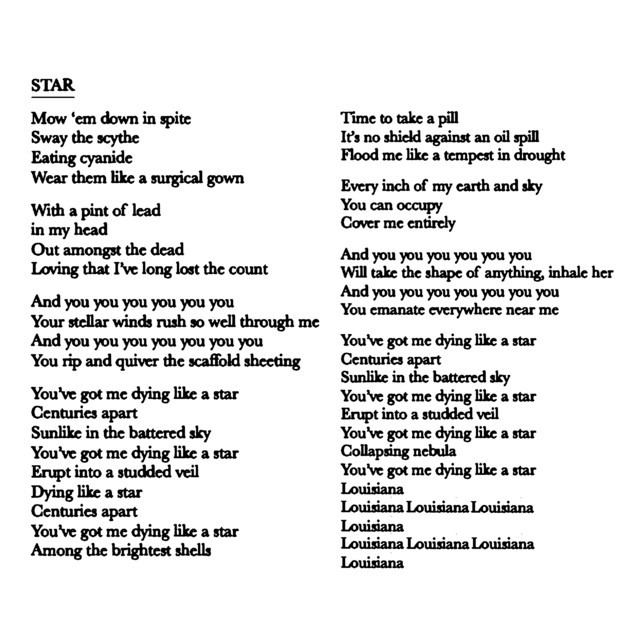
Most love songs want you to survive them. "Star" doesn't. Iceage opens with scythes and cyanide and a narrator who has lost count of the damage, and somehow by the chorus all of that wreckage becomes the most awe-inspiring thing in the sky. The central tension here is that destruction and beauty are not opposites. They're the same event, just viewed from different distances.
The dying star isn't a symbol of tragedy. It's the brightest thing the narrator has ever seen, and they are inside it.
Verse 1
Already past the point
The song doesn't ease you in. The narrator arrives already wrecked, already numb to the toll.
"With a pint of lead in my head / Out amongst the dead / Loving that I've long lost the count"
That last line is the key. The narrator isn't horrified by the damage. They're almost relieved by it. Losing count means the accounting is over. There's a dark freedom in that, the freedom of someone who stopped trying to measure how badly things have gone and just kept moving.
The violence in the imagery here, scythes, cyanide, surgical gowns, isn't melodrama. It's texture. It tells you the emotional register before the love interest even appears.
Pre-Chorus
You move through everything
Then the "you" arrives, and the song's entire atmosphere shifts.
"Your stellar winds rush so well through me / You rip and quiver the scaffold sheeting"
The repeated "you, you, you, you" feels almost like an incantation, like the narrator is trying to locate someone who keeps slipping past definition. Stellar winds don't ask permission. They don't negotiate. They move through whatever is in front of them, and the scaffold sheeting ripping is not a complaint. It sounds like relief.
This person doesn't just affect the narrator. They pass through them completely.
Chorus
Dying as the highest form
The chorus is where Iceage makes their boldest claim. Being destroyed by this person isn't a failure. It's a stellar event.
"You've got me dying like a star / Centuries apart / Sunlike in the battered sky"
A dying star doesn't go quietly. It erupts, collapses, scatters itself into a nebula that seeds new matter across the cosmos. "Centuries apart" is crucial because it frames the dying as something so vast it can't even be witnessed in a single lifetime. The narrator isn't mourning the end. They're marveling at the scale of it.
"Erupt into a studded veil" lands like a visual of that final moment, catastrophic and luminous at once. Dying here is the most alive the narrator has ever been.
Verse 2
No defense left, no desire for one
The second verse drops the cosmic imagery briefly and gets surprisingly concrete.
"Time to take a pill / It's no shield against an oil spill"
Whatever coping mechanism the narrator reaches for, it's already inadequate. An oil spill doesn't respond to pills. It saturates everything, gets into the ground, the water, the air. That's exactly what the next lines confirm.
"Every inch of my earth and sky / You can occupy / Cover me entirely"
There's no resistance here and crucially, no attempt at resistance. "Cover me entirely" isn't a cry for help. It's an invitation. The narrator has moved from losing count of the damage to actively welcoming total occupation.
Pre-Chorus
A presence that fills every shape
The second pre-chorus pushes the "you" even further into something beyond a person.
"Will take the shape of anything, inhale her / You emanate everywhere near me"
The sudden "her" is the only gendered word in the whole song, and it arrives almost by accident, buried in a line about formlessness. It makes the "you" briefly, startlingly human before the next line dissolves them back into atmosphere. "Emanate everywhere" is not something a person does. It's something a presence does, something that has moved beyond a body into the air around the narrator.
Chorus
The collapse becomes a place
The final chorus adds two new images that change the weight of everything before them.
"Collapsing nebula / Louisiana"
"Collapsing nebula" is the scientific endgame of a dying star, the moment when the remnants fold inward and something new might eventually form. It's the most precise the song gets about what this kind of dying actually produces. And then Louisiana, repeated like a chant, breaks the cosmic frame entirely.
Louisiana is swamp and heat and flood and a specific American geography of loss and beauty. Pairing it with a collapsing nebula doesn't deflate the imagery. It grounds it. The vastness of dying like a star and the specific ache of a place like Louisiana are the same feeling at different scales. Both are about something overwhelming, gorgeous, and impossible to stop.
Conclusion
Magnitude over survival
"Star" opens with a narrator already running on numbness and closes with them chanting the name of a place that carries its own mythology of beautiful ruin. The song never resolves the destruction. It reframes it. Dying like a star means the ending is the event, the thing worth witnessing, the thing that makes light visible at all. Iceage isn't romanticizing self-destruction so much as insisting that some forces are simply too large to survive, and that surviving was never really the point.


Comments
Loading comments…